Before the fire fell, there was waiting. Before the sound of a mighty wind filled the house, there was silence, prayer, and expectation. The Apostles had seen the risen Lord and watched Him ascend into Heaven. Yet they still had to wait for the promise of the Father.
They were no longer standing beside the empty tomb in wonder. They were no longer simply rejoicing that Jesus had conquered death. Now they were gathered in the Upper Room, holding on to His promise. Something was coming, but they did not yet know how it would change them.
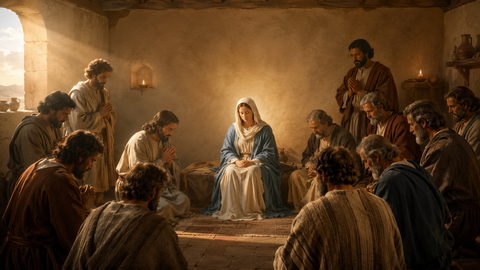
Sacred Scripture tells us that after the Ascension, the Apostles returned to Jerusalem and gathered in prayer. They were not alone. Acts tells us that they persevered in prayer “with Mary the mother of Jesus.” Before Pentecost became fire, courage, and proclamation, it first became prayer with Mary.
They Returned to the Upper Room
The Upper Room was already a sacred place in the memory of the Apostles. It was the place where Jesus had given Himself to them in the Eucharist. It was the place where He had washed their feet. It was the place where He had spoken of love, sorrow, betrayal, and peace.
After the Ascension, they returned there not to hide forever, but to wait. Jesus had told them to remain in the city until they were clothed with power from on high. They had received His promise, but they had not yet received the fullness of the Gift. So they prayed.
This is important for every Catholic soul to remember. The Apostles did not rush ahead on their own strength. They did not begin their mission by relying on confidence, talent, or planning. They waited until the Holy Spirit came.
Mary Was There as Mother
In the middle of that waiting, Scripture gives us one quiet but powerful detail. Mary was there. She was with the Apostles in prayer. The Mother of Jesus was also present at the beginning of the Church’s public mission.
Mary’s presence in the Upper Room was not ornamental. She was not simply a beautiful figure in the background. She was the woman who had already received the Holy Spirit at the Annunciation. She knew what it meant to surrender completely to God.
The Apostles were waiting for the promise of the Father. Mary had already shown the Church what a soul filled with the Holy Spirit looks like. She knew how to wait, how to trust, and how to say yes. Her presence helped teach the Apostles how to prepare their hearts.
Mary did not cause Pentecost. She did not replace Christ or command the Holy Spirit. She prayed with the Apostles and stood among them as Mother. Her role was quiet, humble, maternal, and deeply powerful.

A Mystic’s Window Into the Cenacle
Catholic tradition has always loved to meditate on sacred moments with reverence. Scripture gives us the foundation, and the writings of the saints and mystics can sometimes help the heart imagine and pray. Still, the Church teaches us to be careful. Private revelations are not Scripture, and Catholics are not required to believe them.
Blessed Anne Catherine Emmerich was a Catholic mystic whose visions have nourished the devotional imagination of many faithful readers. Her writings should not be treated as doctrine or as equal to the Bible. They can be received as a devotional window, always beneath Scripture and Church teaching. In that spirit, her reflections can help us enter more prayerfully into the scene of Mary in the Upper Room.
Venerable Mary of Agreda also wrote about Mary and the early Church in a deeply devotional way. Her writings, like all private revelation, must be read with discernment. They are not meant to add to the faith, but to help the faithful love Christ more deeply. When read properly, they can draw the heart toward prayer, humility, and love for Our Lady.
The Days of Preparation According to the Mystics
Blessed Anne Catherine Emmerich describes the Upper Room as a place prepared for prayer. In her vision, the room was arranged with reverence and beauty, almost as if creation itself was waiting for the coming of the Holy Spirit. This image is not doctrine, but it helps the Catholic imagination enter the silence before Pentecost. It reminds us that God often prepares the soul quietly before filling it with grace.
“The whole interior of the Last Supper room was, on the eve of the feast, ornamented with green bushes in whose branches were placed vases of flowers.”
This small detail gives the scene a gentle tenderness. The Cenacle was not only a room of fear. It was becoming a place of expectation. The Apostles were being gathered, steadied, and prepared.
Emmerich also places the Blessed Virgin among the praying disciples. She is present, but not in a loud or dominating way. Her presence is humble, veiled, and maternal. This is often how Mary works in the life of the Church.
“Opposite him in the doorway leading from the entrance hall stood the Blessed Virgin, her face veiled.”
This image is beautiful because it feels so true to Mary’s way. She does not need to draw attention to herself. She leads souls to Jesus by prayer, silence, and faithfulness. In the Upper Room, she teaches the Apostles how to wait for the Holy Spirit.
United in Prayer Around Mary
Venerable Mary of Agreda describes the Apostles and disciples gathered with Our Lady as they waited for the promised Spirit. Her words echo the biblical truth that Mary was present with them in prayer. She presents Mary not as separate from the Church, but as the maternal heart within it. The disciples wait together, encouraged by her presence.
“In the company of the great Queen of heaven, and encouraged by Her, the twelve Apostles and the rest of the disciples and faithful joyfully waited for the fulfillment of the promise of the Savior.”
This line helps us understand Mary’s role with tenderness. She encouraged them. She did not take the place of the Holy Spirit, but helped dispose their hearts to receive Him. She was Mother to fearful disciples who were about to become courageous witnesses.
The Apostles had different personalities, wounds, memories, and weaknesses. Peter had denied the Lord. Thomas had doubted. Others had fled during the Passion. Yet in the Upper Room, they were being gathered into one heart.
Mary of Agreda describes this unity as a work of charity among the disciples. Their prayer was not scattered or divided. They were waiting together for the same Gift. This unity was part of their preparation for Pentecost.
“They were so unanimous and united in charity, that during all these days none of them had any thought, affection or inclination contrary to those of the rest.”
The Holy Spirit loves unity. He does not come to strengthen pride, rivalry, or division. He comes to make many hearts one in Christ. Mary helps gather the family of God into prayerful unity.
Mary’s Prayer Before Pentecost
Catholics have always recognized Mary as a powerful intercessor. This does not mean she replaces Jesus, who alone is our Redeemer. Mary’s intercession depends completely on Christ and always leads us back to Him. In the Upper Room, she prays as Mother of the Church.
Mary of Agreda presents Our Lady as praying for the coming of the Holy Spirit upon the Apostles. This should be read devotionally, not as an addition to Scripture. It helps us imagine Mary’s maternal concern for the frightened and waiting disciples. She desired them to receive the Gift Jesus had promised.
“This petition of our Redeemer in heaven was supported on earth by most holy Mary in a manner befitting the merciful Mother of the faithful.”
This is a tender way to think of Mary before Pentecost. Christ intercedes in Heaven, and Mary prays on earth with the Church. She is not the source of grace, but she is the Mother who asks. She teaches us to ask with humility and trust.
When we ask Mary to pray for us, we are doing something deeply biblical in spirit. We are asking the Mother of Jesus to stand with us in prayer. We are asking her to help our hearts become open to the Holy Spirit. We are entering our own little Upper Room with her.
When the Hour Was Near
The morning of Pentecost came after days of waiting. Scripture tells us that they were all together in one place. Suddenly, a sound like a strong driving wind filled the house. Then tongues as of fire appeared and came to rest on each of them.
Mary of Agreda’s account invites us to imagine the prayerful moments just before this descent. She presents Our Lady as encouraging the Apostles, disciples, and holy women to pray more fervently. Her motherly presence points them toward hope. The promise of Jesus was about to be fulfilled.
“On Pentecost morning the blessed Virgin Mary exhorted the Apostles, the disciples and the pious women… to pray more fervently and renew their hopes.”
This is the voice of a Mother. Pray more fervently. Renew your hope. The hour is near.
How often our own hearts need to hear the same message. When prayer feels dry, Mary tells us to continue. When fear returns, she tells us to hope. When God seems delayed, she teaches us that waiting can become holy.
The Fire Falls
At Pentecost, the waiting became mission. The silence became proclamation. The fearful Apostles became courageous witnesses. The Church was filled with the Holy Spirit and sent into the world.
Mary of Agreda describes the descent of the Holy Spirit in vivid devotional language. Her words echo the biblical account of wind, fire, and divine power. The scene is not meant to distract us from Scripture, but to help us meditate on it. The Church is born in prayer, gathered around Mary, and filled by the Spirit.
“At the third hour, when all of them were gathered around their heavenly Mistress and engaged in fervent prayer, the air resounded with a tremendous thunder and the blowing of a violent wind.”
The fire of Pentecost did not fall on scattered hearts. It fell upon those gathered in prayer. It came to a Church that had learned to wait. It came where Mary was present as Mother.
At Calvary, Mary stood beneath the Cross when everything seemed dark. At Pentecost, she was present when the Church was filled with light. She had accompanied Jesus in His suffering. Now she accompanied His disciples as they received the Spirit for mission.
What Mary Teaches Us About Receiving the Holy Spirit
If we want to prepare for Pentecost, we should not only look at the Apostles. We should look at Mary. She teaches us the posture of a soul ready for the Holy Spirit. She teaches us humility, silence, surrender, and faith.
Mary shows us that the Holy Spirit is received in prayer. She shows us that waiting is not wasted when it is offered to God. She teaches us to remain faithful even when we do not yet understand what God is doing. She helps us trust that the promise of Jesus will be fulfilled.
Mary also teaches us that the Holy Spirit forms unity. The Apostles did not receive the Spirit as isolated individuals pursuing separate missions. They were gathered together as the beginning of the Church. In our homes, families, and parishes, we need that same grace of unity.
A family can become an Upper Room when it prays together. A heart can become an Upper Room when it turns away from distraction and opens itself to God. A parish can become an Upper Room when people stop competing and begin interceding for one another. Mary helps gather scattered hearts back to Jesus.
Enter Your Own Upper Room
Pentecost is not only an event from the past. It is a grace the Church continues to ask for. Every year, the days before Pentecost invite us to wait with the Apostles and pray with Mary. They invite us to ask the Holy Spirit to come again into our lives.
Ask Mary to prepare your heart as she helped prepare the Apostles. Ask her to gather what is scattered within you. Ask her to teach you how to wait with faith. Ask her to make your soul quiet enough to hear God.
Come, Holy Spirit. Form in us the openness You found in Mary. Gather our scattered hearts. Make us faithful witnesses of Jesus.