
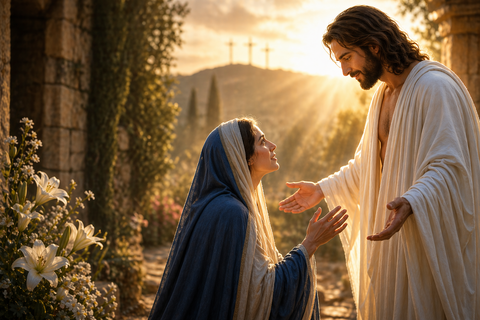
Before dawn breaks on Easter morning in the Philippines, there is a quiet stirring in parishes and streets. Veiled images are carried in procession, and candles flicker softly in the dim light. There is a lingering ache in the air, yet it is filled with expectation. When the moment finally comes and the veil is lifted, the Mother meets her risen Son. It is a simple gesture, yet one that never fails to move the heart.
This is the Salubong.
For generations of Filipino Catholics, it has been more than a cherished custom. It is a living meditation that gives form to a deep spiritual longing. It expresses the hope that love is stronger than death and that sorrow does not have the final word. In that tender encounter between the images of Christ and His Mother, many recognize something profoundly true about Easter. It feels not only like victory, but like reunion.
This quiet beauty also invites a deeper question that has echoed through centuries of Catholic reflection. Did the risen Christ first appear to His Mother? The Gospels do not explicitly tell us that He did. They faithfully recount His appearances to Mary Magdalene, the apostles, and many others, and these accounts belong to the heart of divine revelation. The Church holds them with certainty.
Yet within the rich life of Catholic devotion, there has long been a gentle and thoughtful meditation on the possibility of another meeting. It is not presented as doctrine, nor as a replacement for Scripture, but as a pious tradition that reflects on what would be fitting in the mystery of love between Christ and His Mother. The distinction matters. What we contemplate here belongs to private revelation and devotional reflection, not to the binding truths of the Gospel. Still, it has drawn the hearts of many into a deeper appreciation of Easter’s tenderness.
Blessed Anne Catherine Emmerich offers one such contemplation, describing an encounter that is marked by intimacy rather than spectacle. In her vision, she recounts a moment hidden from the world yet filled with meaning:
“I saw the Mother of God alone, kneeling in prayer, filled with an unspeakable longing. Suddenly, the place was filled with light. I beheld the Savior, resplendent and glorious, standing before her. He spoke to her, and she rose and embraced His feet. There were no words that I could hear, but their union was full of heavenly joy, a joy beyond all expression.” — Blessed Anne Catherine Emmerich, The Life of Jesus Christ and Biblical Revelations
There is a quiet depth in this vision that draws the soul into contemplation. The Mother who remained faithful beneath the Cross now beholds her Son alive. The silence between them speaks of a love that no words can contain. It is not a public proclamation, but a deeply personal consolation.
Venerable Mary of Agreda, in her Mystical City of God, reflects on this mystery in a way that emphasizes the transformation within Mary’s heart. Her account invites us to consider the fullness of Easter joy as experienced by the one who suffered most closely with Christ:
“At that moment the great Queen of heaven felt within her the divine presence of her most holy Son, and the joy of her soul was so great that no tongue can describe it. The sorrow of her most pure heart was changed into a jubilee so profound and so exalted that it surpassed all the joys of the angels. The Lord appeared to her full of glory, and she adored Him as her God and embraced Him as her Son.” — Venerable Mary of Agreda, The Mystical City of God
Here, the movement from sorrow to joy becomes unmistakably clear. The grief of Calvary does not disappear; it is transformed. The heart that once held unimaginable sorrow now overflows with a joy beyond earthly measure. It is a joy rooted in love, a joy that springs from faith that endured even in darkness.
Saint John Paul II, while remaining firmly grounded in Scripture, spoke of this possibility with thoughtful restraint. He did not declare it as fact, but acknowledged its spiritual fittingness within the mystery of the Resurrection:
“It is legitimate to think that, in all probability, the Mother was the first person to whom the risen Jesus appeared.” — St. John Paul II, General Audience, May 21, 1997
His words reflect a tradition that does not seek to go beyond the Gospel, but to meditate more deeply on it. The one who shared most intimately in Christ’s suffering would fittingly be among the first to share in His joy. It is a reflection born not from speculation, but from the logic of love.
This is where the Salubong takes on even greater meaning. It is no longer only a reenactment, but a devotional window into this mystery. The lifting of the veil becomes a symbol of sorrow giving way to joy. The meeting of Mother and Son becomes a reflection of a deeper spiritual truth. Love that has endured suffering is not forgotten. It is fulfilled.
Mary’s Easter joy is inseparable from her fidelity. She remained when others fled. She believed when hope seemed extinguished. Her joy is not a sudden gift detached from her suffering, but the fruit of a love that never wavered. In her, we see that the Resurrection does not erase the Cross, but transforms it. The wounds remain, yet they shine with glory.
For those who carry their own hidden sorrows, this truth offers quiet consolation. There are moments when faith feels like waiting in darkness, when prayers seem unanswered and hope feels distant. In those moments, Mary stands as a companion. She knows what it is to remain faithful without visible consolation. And because she remained, she also knows the joy of seeing Christ again.
The Salubong invites each of us into that same movement. It reminds us that sorrow is not the end of the story. It teaches us that waiting, when joined to faith, opens the heart to a deeper encounter. It reveals that Easter joy is not only something proclaimed, but something received.
Whether or not we can say with certainty that Christ first appeared to His Mother, we can recognize the profound truth that no one received the joy of the Resurrection more deeply than she did. Her heart, which suffered in perfect union with her Son, now rejoices in perfect union with His victory.
In the quiet beauty of this mystery, we are invited to see our own lives reflected. The risen Christ does not forget those who wait for Him. He comes, often quietly and in ways unseen, but always with the power to transform sorrow into joy. Through Mary, we learn to recognize Him.
And so the Salubong becomes more than a moment in time. It becomes a promise. The veil will be lifted. The sorrow will not remain. And the faithful heart, like Mary’s, will one day behold the risen Lord and be filled with a joy that no darkness can overcome.