On a warm July night in Paris in 1830, a young novice lay awake in the silence of her convent room. Her name was Catherine Labouré, a 24-year-old Daughter of Charity. For weeks she had begged St. Vincent de Paul for a grace she longed for with her whole heart: to see the Blessed Mother with her own eyes.
That night, heaven responded.
A Child at the Bedside
Just before midnight, Catherine heard her name called. When she opened her eyes, a small, radiant child stood at her bedside, glowing with a light not of this world. He spoke clearly and gently: “Come to the chapel. The Blessed Virgin awaits you.”
Catherine dressed quickly and followed him. The corridor was dark, yet as they walked, she noticed something astonishing. Every door they approached—doors normally locked at night—opened on their own. When they entered the chapel, it should have been pitch black, but instead Catherine found it filled with a soft, heavenly brilliance, though not a single candle was lit.
The child led her toward the sanctuary, then turned and said, “Here is the Blessed Virgin.”
The Mother Who Drew Close
Mary appeared and seated herself in the priest’s chair. Catherine later wrote that she “flew to her,” fell to her knees, and placed her hands on Mary’s lap as a child would with her mother. In that moment, every fear dissolved. What remained was a peace so deep Catherine could hardly describe it.
Mary spoke with her for nearly two hours. Her words were filled with both tenderness and gravity. She spoke of trials that would come to France and to the Church, but she also spoke of God’s mercy. Then she turned Catherine’s attention toward the altar and made a promise that would echo across centuries: “Come to the foot of this altar. Here, graces will be poured upon all who ask with confidence.”
This was more than comfort. It was a revelation of Mary’s ongoing maternal role in the Church—a role intimately connected with the distribution of God’s grace.
The Vision of the Medal
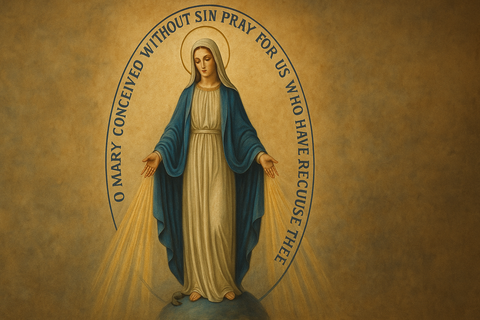
On November 27, 1830, during evening prayer, Mary appeared to Catherine once more. This time the vision was filled with symbolism that Catherine would never forget. Mary stood on a globe, her foot firmly crushing the serpent. Light streamed from her hands in radiant, cascading rays. Catherine noticed that each ring Mary wore held a precious stone, and from most of these stones dazzling rays poured down toward the earth.
Mary explained that the rays were the graces she obtained for those who asked. She also revealed something heartbreaking: some of the gems emitted no rays because souls simply did not ask for the graces God desired to give them.
Around Mary’s figure appeared an oval frame with the words: “O Mary, conceived without sin, pray for us who have recourse to thee.”
Then the image turned, as if rotating, and Catherine saw the back of the medal: the large letter M intertwined with a cross, the Sacred Heart of Jesus crowned with thorns, the Immaculate Heart of Mary pierced by a sword, and twelve stars encircling them.
Mary then gave Catherine a mission that would transform the world: “Have a medal struck according to this model. Those who wear it will receive great graces.”
A Medal Heaven Designed
Catherine told her confessor, Fr. Jean-Marie Aladel, who at first hesitated but eventually sought ecclesiastical approval. The first medals were produced in 1832, during a cholera epidemic that was devastating Paris. From the moment the medals were distributed, reports of extraordinary favors began to multiply—healings, conversions, unexpected protection, reconciliations, and interventions that defied explanation.
The faithful themselves began calling it the “Miraculous Medal.”
It was never because the object had power of its own, but because Mary did what she promised: she poured out graces upon all who asked with confidence.
A Silent Catechism of Grace
Everything about the medal communicates truth. Mary stands upon the globe because God entrusted her with a maternal role in the life of the world. The serpent beneath her feet echoes Genesis, where God foretells that the Woman and her seed would crush the serpent’s head. The rays from her hands reveal her intercessory love, ever ready to draw down the gifts of heaven. The inscription affirms her Immaculate Conception, decades before it was formally defined. And the reverse side unites the Hearts of Jesus and Mary, showing how closely the Mother stands beside the Son in the work of salvation.
The Church teaches clearly that Christ is the one Mediator. Yet she also teaches that Mary, entirely dependent on Him and subordinate to Him, participates in the distribution of graces as a mother who intercedes. Through her, Christ’s gifts reach hearts more readily, not because He is distant, but because she draws us more intimately toward Him.
The Miraculous Medal depicts this beautifully. It is a theological truth expressed not in words but in light: Christ is the source of grace, and Mary, by His will, is the loving Mother through whom those graces touch the world.
A Story Still Unfolding
Nearly two centuries have passed since those nights at Rue du Bac, yet the stream of grace has not stopped. Countless souls testify to moments of deep conversion, unexpected peace in suffering, dramatic returns to the faith, reconciliation within families, and quiet miracles that arrive precisely when needed.
Wherever this medal is worn with trust, Mary continues the promise she made to Catherine—that grace will never be withheld from those who ask with confidence.
How to Live This Devotion Today
To wear the Miraculous Medal is to carry a reminder of heaven’s nearness. It is a way of placing yourself under the mantle of the Mother who desires only to lead you to her Son. The graces associated with the medal are not mechanical or magical; they flow from a relationship of trust. Every time your hand touches it, you are invited to whisper the prayer inscribed upon it: “O Mary, conceived without sin, pray for us who have recourse to thee.”
In those words lies a simple truth of the Catholic faith: grace is never far from the soul that turns to Mary, because Mary never ceases to turn toward Jesus.
A Prayer to Our Lady of the Miraculous Medal
O Mary, conceived without sin, pray for us who have recourse to thee.
Mother of God and our Mother, thank you for every grace your Son pours into our lives through your loving intercession.
Keep us under your mantle of protection and lead us always to the Heart of Jesus. Amen.