For generations, many Catholics have turned to a simple and consoling prayer: “St. Joseph, patron of a happy death, pray for us.” These words appear in prayer books, devotional cards, and quiet petitions whispered in times of illness or at the bedside of the dying. The prayer reflects a deep instinct within the Christian heart, a hope that the final moment of life may unfold under the mercy of God.
In Catholic spirituality, a “happy death” does not refer to comfort or ease. It refers to a soul that departs this life reconciled with God and trusting completely in Christ. Such a death is considered happy because the soul leaves the world in grace and hope, ready to meet the Lord.
St. Joseph has long been invoked for this grace. The tradition rests on the belief that Joseph died in the presence of Jesus and Mary, the two persons he loved most on earth. Because his final moments were blessed by their presence, Catholics have entrusted their own final hour to his intercession.
What Catholics Mean by a “Happy Death”
The expression “happy death” may seem surprising in modern language, yet it carries a profound spiritual meaning. Happiness here refers not to emotion but to the state of the soul. A happy death is the death of someone who leaves this world in friendship with God.
The Church encourages the faithful to prepare for this moment through repentance, prayer, and perseverance in faith. Catholics frequently pray for this grace in the Hail Mary, asking the Blessed Virgin to intercede “now and at the hour of our death.” In this prayer the Church recognizes that the final moment of life is spiritually decisive.
Death, in the Christian understanding, is not merely an ending. It is the passage into eternal life. A happy death therefore means meeting Christ with a heart that still belongs to Him.
Why St. Joseph Is Invoked This Way in Catholic Tradition
St. Joseph’s connection with the grace of a happy death grows naturally from the story of his life. The Gospels present Joseph as the faithful guardian of the Holy Family, entrusted by God with the protection of Jesus and Mary. He appears prominently in the early chapters of the Gospel narratives but disappears before the beginning of Christ’s public ministry.
Because Joseph is absent from the later Gospel accounts, Christian tradition has long believed that he died before Jesus began His preaching. This silence in Scripture led the faithful to contemplate how Joseph’s earthly life might have ended.
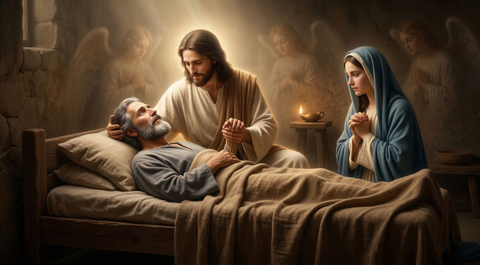
Devotional tradition imagines a scene of profound tenderness. Joseph, who had protected and cared for the Child Jesus, now approaches his own final hour while the grown Savior remains near him. Mary, who shared Joseph’s life and labors in Nazareth, stands beside him in prayer.
This vision of Joseph’s death gradually shaped Catholic devotion. If Joseph departed this life with Jesus and Mary beside him, it is fitting that Christians should ask his help when their own final hour approaches.
What the Church Teaches About Private Revelation
The descriptions of St. Joseph’s death preserved in mystical writings belong to what the Church calls private revelation. Public Revelation, which is the foundation of the Catholic faith, is contained in Sacred Scripture and Sacred Tradition and is fulfilled in the person of Jesus Christ.
Private revelations, on the other hand, are spiritual insights granted to certain holy men and women throughout the history of the Church. These experiences may inspire devotion or deepen meditation on the Gospel, but they do not belong to the deposit of faith and are not required beliefs.
The Catechism of the Catholic Church explains that private revelations “do not belong to the deposit of faith” and that their role is not to complete Christ’s revelation but to help the faithful live it more fully. Catholics may therefore read the writings of mystics with reverence while recognizing that such accounts are devotional reflections rather than historical certainties.
Two mystics whose writings describe the death of St. Joseph are Venerable Mary of Ágreda and Blessed Anne Catherine Emmerich. Their narratives provide vivid contemplations of the final moments of the earthly guardian of the Redeemer.
The Mystical Account of St. Joseph’s Death in Venerable Mary of Ágreda
The seventeenth-century Spanish mystic Venerable Mary of Ágreda wrote a spiritual work titled The Mystical City of God. In it she recounts contemplative visions concerning the life of the Virgin Mary and the Holy Family. Her description of Joseph’s final illness emphasizes the quiet holiness of the home of Nazareth.
Ágreda writes that Joseph’s final days were marked by peace and spiritual consolation. Jesus and Mary remained constantly at his side, caring for him with tenderness as his strength declined. The home where Joseph had worked and prayed for many years became a place of prayerful vigil.
She describes the moment of Joseph’s passing with these words: “The blessed hour arrived in which the Most High called His servant Joseph from this mortal life. The Redeemer of the world assisted him in his last moments, and the Queen of Heaven served him with maternal love and reverence.”
Ágreda also describes Joseph turning his heart toward Christ with profound trust as death approached. In another passage she writes: “The most fortunate of men closed his eyes in peace while Jesus and Mary were present, and his soul passed from their loving company on earth to the eternal vision of God.”
Her account highlights Joseph’s serenity and holiness. The death of Joseph is presented not as a dramatic event but as the peaceful completion of a life lived faithfully in God’s service.

The Mystical Witness of Blessed Anne Catherine Emmerich
Another contemplative description of Joseph’s death appears in the visions of Blessed Anne Catherine Emmerich, a nineteenth-century German mystic. Her spiritual experiences were recorded by the poet Clemens Brentano and later published in works describing the life of Christ and the Blessed Virgin Mary.
Emmerich portrays the final illness of Joseph as gentle and filled with affection within the Holy Family. She describes Jesus and Mary caring for Joseph in the small home of Nazareth while his life slowly came to its end.
In one passage she recounts the final moment of Joseph’s life:
“Joseph was lying on his couch with Jesus on one side and Mary on the other. He pressed the hand of Jesus and looked upon Him with indescribable love, and thus peacefully breathed his last.”
Elsewhere she reflects on the tenderness of the moment and the holiness of Joseph’s passing: “I saw the soul of Joseph leaving his body with great peace, consoled by the presence of Jesus and the prayers of Mary.”
In these visions Joseph’s death is marked by simplicity and love. The carpenter of Nazareth, who had spent his life protecting the Savior, is comforted in return by the presence of the Lord he served.
Why This Supports His Patronage of a Happy Death
The tradition surrounding Joseph’s death helps explain why the Church entrusts the final hour of life to his intercession. Joseph spent his life close to Jesus and Mary, fulfilling his vocation with humility and obedience. According to devotional tradition, he also departed this life in their presence.
For Christians, this image carries deep consolation. It suggests that the faithful servant of God is not abandoned in the moment of death. Instead, the soul that has lived close to Christ may hope to encounter Him with peace.
Joseph therefore becomes a compassionate patron for those approaching their final hour. The one who died near the Savior is believed to intercede for those who ask that their own passing may unfold in God’s grace.
What St. Joseph Teaches About Preparing for Death
The devotion to St. Joseph as patron of a happy death ultimately points to the importance of living well. Joseph’s peaceful passing reflects the fidelity of his entire life. His holiness was not built on dramatic acts but on daily obedience to God’s will.
Christians prepare for a holy death through a life of faith. Prayer, repentance, and the sacraments form the foundation of this preparation. The faithful seek to remain close to Christ throughout their lives so that their final moment may be one of trust rather than fear.
Joseph’s hidden life in Nazareth offers a model of this quiet holiness. His example reminds believers that the path to a peaceful death is found in daily fidelity to God.
A Consoling Patron for the Final Hour
The title “patron of a happy death” therefore reflects the hope of the Christian life. It reminds believers that death does not separate them from God but brings them into His presence. The faithful who entrust themselves to Christ may face the final moment with confidence in His mercy.
St. Joseph’s peaceful passing has become a symbol of this hope. The man who once protected the Child Jesus was himself comforted by the Savior at the end of his life. The scene imagined by Christian devotion reflects the tenderness of God toward His faithful servants.
For this reason Catholics continue to pray the ancient petition that has echoed for centuries: “St. Joseph, patron of a happy death, pray for us.”