The Gospel tells us simply that Mary “brought forth her firstborn Son, and wrapped Him in swaddling clothes, and laid Him in a manger” (Luke 2:7). The words are spare, almost austere. They do not describe the cold of the night, the roughness of stone, the aching fatigue of a young mother who had walked for days. They do not linger on the silence that followed the Child’s first cry, or on the moment when heaven seemed to hold its breath.
Yet the mystics linger there. They remain within that cave, kneeling beside Mary, watching how God chose to enter the world—not with splendor, but with holy poverty. Not with abundance, but with deliberate emptiness.
Venerable Mary of Ágreda writes of this poverty not as an accident of circumstance, but as a mystery freely embraced by God Himself:
“The great Queen of heaven remained alone with her Son, the Creator of the universe, whom she had brought forth without pain, and whom she now held in her arms. She had no earthly comforts, no warmth except that which her own body gave, and no human assistance. Yet her heart overflowed with joy and reverence, for she knew that He whom she held was the eternal Word made flesh, choosing poverty and abasement for the salvation of men.” — Venerable Mary of Ágreda, The Mystical City of God
Bethlehem was not merely poor. It was emptied. Stripped of every consolation that might distract from the truth being revealed: that God had come not to possess, but to give; not to be served, but to serve.
The cave itself, according to the mystics, bore the marks of abandonment. It was not prepared for life, much less for birth. And yet it became a sanctuary.

Blessed Anne Catherine Emmerich describes the place with unsettling clarity:
“The cave was dark and cold, and the floor was damp and uneven. There was no cradle prepared, no covering but the poor cloths Mary had brought with her. The place was scarcely fit for animals, yet it was here that the Redeemer of the world chose to be born. All was simplicity, want, and poverty, such as the world despises, but such as God had chosen from eternity.” — Blessed Anne Catherine Emmerich, The Life of the Blessed Virgin Mary
This was not the poverty of neglect. It was the poverty of intention. The King of kings chose nothing so that no one could fear approaching Him. He chose the lowest place so that no soul could say, “This God is not for me.”
And Mary understood.
The mystics are unanimous in this: Our Lady did not merely endure the poverty of Bethlehem. She embraced it. She received it as part of her Son’s mission, and she sanctified it by her reverence.
Mary of Ágreda recounts how, immediately after the Birth, Mary did not seek rest or relief, but adoration:
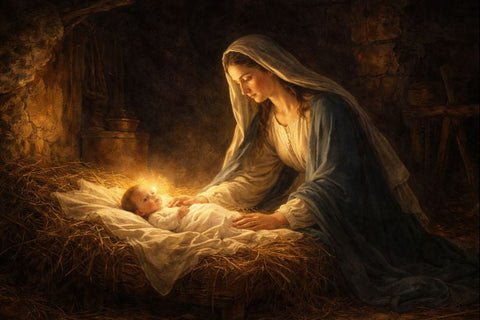
“The most blessed Mary, seeing her divine Son born, fell upon her knees in profound humility and adoration. She offered Him to the eternal Father, thanking Him for the favor of allowing her to become the Mother of the incarnate Word. In this adoration she remained a long time, forgetting herself entirely, absorbed in love and reverence for the Child whom she knew to be her God.” — Venerable Mary of Ágreda, The Mystical City of God
In that moment, the cave became a temple. The straw became an altar. Poverty became the setting of the first Eucharistic posture: kneeling before God made small.
The silence of Bethlehem is not empty silence. It is filled with meaning. The mystics tell us that the world was quiet because heaven was speaking—not in thunder, but in humility.
St. Bridget of Sweden was shown this silence in one of her revelations:
“The Virgin knelt down in prayer, and her back was turned to the manger. Suddenly I saw the Child move and glow with an indescribable light, and in a moment He was born. The angels sang softly, and the Virgin adored Him with folded hands and great reverence. There was no noise, no confusion, only peace and holy stillness.” — St. Bridget of Sweden, Revelations
This stillness reveals something essential about the Heart of Christ. He did not burst into the world demanding attention. He waited to be received. He entrusted Himself first to the hands of a poor mother, in a place the world would never choose.
Bethlehem teaches us how God wishes to come to us still.
Not when we are ready. Not when our lives are well furnished. Not when our hearts are warm and orderly. He comes when there is room only because there is nothing else there.
Blessed Anne Catherine Emmerich reflects on this interior poverty with piercing insight:
“The poverty in which Jesus was born was not only outward. It was the sign of the humility with which He wished to enter the hearts of men. He seeks no adornment, no preparation of pride, but only a place emptied of self, where He may rest and be loved.” — Blessed Anne Catherine Emmerich, The Life of the Blessed Virgin Mary
Mary’s role in this mystery is not passive. She is the one who teaches us how to receive Christ in poverty—without grasping, without fear, without resistance.
Mary of Ágreda writes of her interior disposition that night:
“The humility and love of the great Lady exceeded all that can be imagined. She considered herself less than the earth she knelt upon, and yet she held in her arms the Lord of heaven. Her joy did not arise from comfort or honor, but from seeing the will of God fulfilled in the most perfect manner.” — Venerable Mary of Ágreda, The Mystical City of God
This is Marian poverty: not the absence of dignity, but the fullness of surrender.
In Bethlehem, God teaches us that salvation does not begin with strength, strategy, or abundance. It begins with consent. With openness. With a heart that does not insist on being full before God enters.
The manger still stands before the world as a question.
Will we make room—not by adding more, but by letting go?
The Child still comes quietly. He still chooses nothing. And He still waits to be received in the poverty of a heart willing to kneel.