
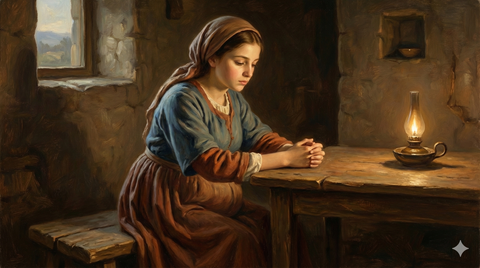
The Gospels tell us almost nothing about how Mary lived during the months before the birth of Christ. They speak simply, almost starkly: she conceived by the Holy Spirit, she visited Elizabeth, she returned home, she journeyed to Bethlehem.
And yet the Church has never believed that these months were empty.
Across centuries, several saints and mystics were permitted to glimpse the hidden life of the Mother of God during that long, silent Advent. Their writings are not Scripture, and the Church does not require belief in them. But they have been read, preserved, and commended because they illuminate what the Gospels leave unsaid—without contradicting them.
Taken together, these accounts reveal a preparation for Christmas that was interior, sacrificial, and almost entirely unseen.
They show us what Mary did while the world waited.

The Interior Silence After the Incarnation
Venerable Mary of Agreda, in The Mystical City of God, describes the moment after the Incarnation as a profound turning inward. Once the Word took flesh within her, Mary’s life became, above all else, a continual act of interior worship.
She writes that Mary remained “in the deepest silence and recollection, pondering within herself the mysteries of the Lord, and offering uninterrupted thanksgiving to the Most High for having chosen her, the least of creatures, to bear within her womb the eternal Word” (The Mystical City of God, Venerable Mary of Agreda).
Agreda emphasizes that this silence was not merely external. Mary did not simply speak less. She lived as one who was constantly aware that God Himself dwelt within her. Her thoughts, her movements, even her breathing were shaped by reverence.
“She conversed continually with the Lord who was incarnate in her womb,” Agreda writes, “adoring Him as her God and loving Him as her Son, humbling herself as His handmaid and offering herself entirely to His divine will” (The Mystical City of God).
This interior life, according to Agreda, did not remove Mary from ordinary responsibilities. It sanctified them.
A Life Ordered Entirely to Prayer
Blessed Anne Catherine Emmerich, whose visions were recorded by Clemens Brentano in The Life of the Blessed Virgin Mary, repeatedly describes Mary’s daily life during her pregnancy as quiet, structured, and deeply prayerful. Emmerich recounts that Mary rose early each day and spent long hours in prayer, often standing, often facing Jerusalem, reciting the Psalms and meditating on the promises God had made to Israel.
“She prayed with extraordinary devotion,” Emmerich relates, “and her prayer was no mere repetition of words, but a continual elevation of her soul toward God, full of love, humility, and submission” (The Life of the Blessed Virgin Mary, Blessed Anne Catherine Emmerich).
Emmerich also notes that Mary frequently reflected on the prophecies concerning the Messiah—not as distant texts, but as living realities already unfolding.
For Mary, prayer during Advent was not preparation for something absent. It was communion with Someone already present.
Preparing Through Hidden Sacrifice and Her Role as Co-Redemptrix
What is striking in Blessed Anne Catherine Emmerich’s visions is how physically demanding this period was for Mary, and how willingly she embraced it. She describes Mary as often tired, sometimes weakened by travel and labor, yet never complaining, never seeking relief for herself.
“She bore all discomfort with perfect patience,” Emmerich writes, “and offered every suffering to God with a joy that sprang from her love” (The Life of the Blessed Virgin Mary).
This theme of suffering freely accepted and consciously offered appears even more strongly in the writings of Venerable Mary of Agreda. Agreda insists that Mary was granted an extraordinary understanding of her Son’s future mission. While not comprehending every detail, she knew enough to unite her heart, her will, and her sufferings to His redemptive sacrifice even before His birth.
“The most prudent Mother,” Agreda writes, “was not ignorant of the mysteries which her Son was to accomplish for the salvation of men, nor of the dolorous path by which He would redeem the world” (The Mystical City of God).
Agreda goes further. She presents Mary not merely as a passive witness to redemption, but as one who freely and knowingly participated in it according to God’s will. From the moment of the Incarnation, Mary consciously joined her own sufferings—physical, emotional, and spiritual—to the future sufferings of Christ.
“She began her cooperation in the work of Redemption from the very moment of the Incarnation,” Agreda writes, “offering herself with her Son to the eternal Father” (The Mystical City of God).
This is the foundation for the Church’s theological understanding of Mary as Co-Redemptrix—not as an equal redeemer alongside Christ, but as the one creature who, by God’s grace, cooperated most intimately and uniquely in His saving work. Her role as Co-Redemptrix begins not at Calvary alone, but here, in the hidden Advent, where she freely consented to suffer with her Son for the salvation of the world.
In Agreda’s vision, Christmas is already marked by the Cross.
An Exterior Life That Looked Entirely Ordinary
Externally, however, nothing in Mary’s life suggested greatness.
Both Blessed Anne Catherine Emmerich and Venerable Mary of Agreda are careful to describe Mary’s outward circumstances as humble to the point of obscurity. She performed ordinary household tasks. She served Joseph quietly. She avoided attention. Those around her saw nothing remarkable.
Emmerich writes that Mary “went about her household duties with gentleness and simplicity, as if she were the least among all,” and that “no one who saw her would have guessed the immeasurable mystery she carried within her” (The Life of the Blessed Virgin Mary).
This hiddenness is perhaps the most challenging aspect of Mary’s preparation for Christmas. There was no visible celebration, no recognition, no external sign that the greatest event in human history was approaching.
Waiting Without Fear for the Birth of Christ
Saint Bridget of Sweden, in her Revelations, offers one of the most intimate descriptions of Mary’s interior disposition as the time of birth drew near. In a vision of the Nativity, Bridget recounts Mary’s words describing how she waited—not with fear, but with profound peace.
“My heart rejoiced,” Mary says, “because I knew that He whom I carried was God and that nothing was impossible to Him” (Revelations, Saint Bridget of Sweden).
Mary did not attempt to control the circumstances of the birth. She did not demand comfort or certainty. She trusted that God, who had begun this work in her, would bring it to completion.
That trust defined her Advent.
What Mary’s Hidden Advent Teaches Us
What these mystics describe is not a sentimental waiting, but a demanding one. Mary prepared for Christmas through silence, prayer, and suffering freely offered to God.
Her silence was a form of attentiveness. By withdrawing inwardly, guarding her heart, and living in continual awareness of the Divine Presence within her, Mary shows us that silence is not an absence, but a posture of readiness. Without it, the soul has no space to receive God.
Her prayer was not occasional or reactive. It ordered her entire day and gave shape to her waiting. Through Scripture, praise, and continual communion with God, Mary teaches us that prayer is not an addition to Advent, but its foundation.
Her suffering was neither accidental nor resisted. It was accepted and consciously offered. Physical weariness, uncertainty, and hidden sorrow became part of her cooperation with God’s will. In this, Mary reveals that suffering, when united to God, becomes a place where grace is at work.
Her life before Bethlehem was already an offering.
For those who read these accounts today, the question they raise is unavoidable. If this is how Mary prepared for the first Christmas, how far have we drifted from her example?
Mary did not prepare by making everything perfect around her. She prepared by making room within her.
She did not ask whether circumstances were ideal. She trusted that God would act within imperfect circumstances.
She did not rush toward Christmas. She waited—silently, prayerfully, sacrificially.
And in that waiting, Mary teaches us how heaven enters the world. Not through haste or noise, but through a heart made silent, prayerful, and willing to suffer for love.