
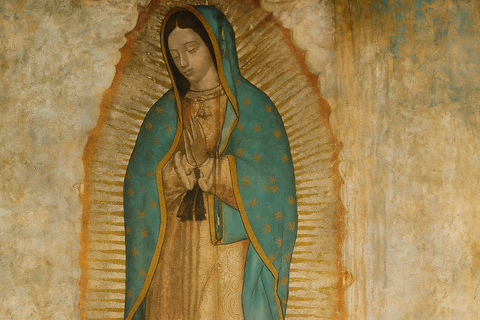
In the winter of 1531, on a hill called Tepeyac outside Mexico City, a humble indigenous widower named Juan Diego encountered a radiant woman who revealed herself as the Blessed Virgin Mary. Over the course of four dawns, the Queen of Heaven spoke to Juan Diego in his native Náhuatl tongue with maternal love, asking him to implore the bishop for a chapel to be built on that hill in her honor.
Skeptical at first, the bishop requested a sign. Obediently, Juan Diego returned to Our Lady, who sent him to the frozen summit of Tepeyac. There, in the bleak of December, he found a miracle of Castilian roses blooming out of season. He gathered the fragrant blossoms in his coarse tilma (cactus-fiber cloak).
When Juan Diego was finally admitted to Bishop Zumárraga’s presence, he opened his tilma to reveal the roses – and something even more astonishing: as the roses tumbled out, Our Lady’s image was imprinted on the fabric. The stunned bishop and all present fell to their knees, overwhelmed by the heavenly sign. Thus began the legend of Our Lady of Guadalupe, an event that would spark the conversion of millions and forever intertwine Mary’s love with the destiny of the Americas.
The basic story of Guadalupe is well known to many Catholics. Yet beyond the initial apparition narrative lies a deeper tale etched in the very threads of Juan Diego’s tilma. This miraculous image – at once a gift of grace and a message in color and symbol – has endured nearly five centuries. In its silent presence, it continues to speak volumes. As we take a closer look, each detail of the tilma becomes a revelation, unfolding like chapters in a sacred story that inspire awe and deepen our devotion to the Mother of God. What follows is a journey into the mysteries and symbolisms of the tilma itself – that fragile cloak “woven by heaven” – which science cannot fully explain and faith never ceases to marvel at.
A Miraculous Portrait on a Humble Tilma
At the heart of the Guadalupe miracle is the tilma itself – a simple cloak of rough agave fibers, the kind worn by the poorest natives. Who would expect such a lowly garment to become the canvas for a heavenly masterpiece? The origin of the image defies any natural explanation. The beautiful portrait of the Virgin Mary did not come from a painter’s brush; it appeared in an instant as Juan Diego unfurled his cloak before the bishop.
The Virgin had given a sign beyond what anyone imagined – her own likeness, left by a divine hand on ordinary cloth. From that moment on, the ayate (cactus-fiber tilma) was no longer ordinary. It was treasured as a miraculous image, reverently installed in a shrine and venerated by countless pilgrims. The very existence of this sacred portrait, unmade by human hands, became a tangible proof of the apparition’s truth and a source of consolation: Mary had not only appeared – she remained with her people through this image, as a loving mother who keeps her children under her mantle.
What’s remarkable is that the image on the tilma has features that no human artist of that era – or any era – could replicate on such material. For one, the fabric is unprimed and unsized, meaning it had no special coating to receive paint. Yet the colored form of the Virgin somehow adhered perfectly to the coarse fibers.
Traditional painting on unsized cactus cloth would be nearly impossible – the pigments would soak and blur. But here the lines are crisp and the colors vibrant. Even more baffling, modern studies have found no brush strokes, no sketches, no under-drawing on the image. It’s as if the portrait formed directly on the fibers, with a technique unknown to any artist.
The Spanish and indigenous witnesses in 1531 certainly believed it was made by God alone. And centuries later, experts like Dr. Philip Callahan (a biophysicist and NASA consultant) confirmed that there are no traces of paint or pigment application on the cloth; under infrared light, the image shows no brushwork or corrections, and parts of it even change slightly in color when viewed from different angles, a subtle iridescence no painter could create.
Little wonder that the faithful refer to this treasured icon as the “painting of God”, a true acheiropoieta – image not made by human hands.
Preserved by a Miracle Across Centuries
If the tilma’s origin was miraculous, so has been its astonishing preservation. Traditionally, a garment like Juan Diego’s – woven from coarse maguey cactus fibers – should have decayed within 20 to 30 years in the best of conditions. Such material is highly perishable; it disintegrates with humidity, sunlight, and time.
Yet nearly 500 years later, Juan Diego’s tilma remains intact and vibrant, its colors still fresh. Scientists can’t explain it. In fact, the tilma hung openly in the old basilica for over a century – from 1531 to 1647 – with no glass protection, exposed to smoke from tens of thousands of candles, to humid salty air, and incessant touching by devotees. Normally, such exposure should have left it in tatters or at least faded beyond recognition.
But the image of Guadalupe defied all odds, surviving where any comparable cloth would have long since fallen apart. Dr. Adolfo Orozco, a physicist who presented at the International Marian Congress in 2009, put it plainly: after exhaustive analysis, no scientific theory suffices to explain why the tilma shows “no sign of deterioration” even after centuries in an environment that causes similar fabrics to disintegrate within a decade.
It seems the hand of God that placed the image also preserves it through time, as if to say this message is still meant for us today.
Not only has the tilma endured the elements, it has also survived accidents and attacks unscathed. In 1785, a worker accidentally spilled strong nitric acid solvent on a large portion of the cloth. Such acid should have burnt holes through it – yet the image suffered no damage, with only a slight stain that faded with time.
Even more dramatically, in 1921 anti-Catholic forces planted a powerful bomb beneath the image. The blast shattered the marble altar, bent a heavy iron crucifix into a horseshoe shape, and blew out windows all around. But the tilma itself was untouched, and even the thin glass covering it did not crack.
Those who witnessed the aftermath in the old basilica saw it as nothing short of a miracle – a visible sign that God protects this image of His Mother. To this day, that bent crucifix is displayed as testimony to how Our Lady’s picture withstood the explosion.
Taken together – the inexplicable durability, the resistance to damage and decay – the tilma’s preservation speaks to a divine guardianship. As one scientist said, its survival is “beyond any scientific explanation”.
This ageless artifact, fragile in material yet enduring in glory, seems maintained by heaven’s hand, preserved so that every generation can encounter the message Mary left on it.
Clothed with the Sun: Heavenly Signs for an Indigenous People
When Juan Diego and his fellow Aztecs first beheld the image on the tilma, they immediately recognized a story told in celestial symbols. The Lady in the image is bathed in golden sunlight, surrounded by rays of sun that form a brilliant mandorla around her. To the native people, this sight spoke volumes. The sun was the greatest god in the Aztec pantheon – the giver of light and life, the one for whom they offered human sacrifices.
Yet here was a woman who outshines the sun. Mary stands in front of the sun’s rays, eclipsing the Aztec sun god Huitzilopochtli, showing that the God she carries is greater than all their false gods.
Still, she does not extinguish the sun’s light entirely – rather, she lets it form a glorious background, as if to say this light is now sanctified and surpassed by a higher truth. The imagery fulfilled the prophecy of Revelation 12:1 – “a woman clothed with the sun” – and the Aztecs, though they didn’t know Scripture, intuitively grasped that this woman had divine favor. The power of the sun was now serving the one true God who sent Mary.
Gazing lower, the natives saw the Lady standing on a crescent moon. In their culture, the moon symbolized the god of night and of fertility. By standing atop the moon, Our Lady signaled victory over the darkness – she had defeated the lunar deity just as she outshone the sun.
For Christians, of course, the moon under her feet also resonates with Revelation 12: “the moon under her feet”, a sign of Mary’s purity and victory over sin and falsehood. The blending of meanings is beautiful: to the Aztecs it meant their night-god is powerless before her, and to the Spanish missionaries it confirmed Mary’s role as the Immaculate Virgin, ever-virginal and triumphant over evil.
The position of the Lady – blocking the sun and standing on the moon – showed the Aztecs that the old gods had not truly won. There was a greater power at work, the God of Heaven, and Mary was His messenger.
Even the small angel at Our Lady’s feet carried profound meaning for the indigenous people. The angel in the image supports Mary as if carrying her on its shoulders, and significantly, this angel has eagle’s wings. In Aztec mythology, the eagle was the messenger that delivered sacrificial offerings to the gods. Yet here the eagle-winged angel bears not a sacrifice of blood, but Mary herself, who in turn carries the Divine Child, Jesus, the ultimate sacrifice of love.
This detail signaled that human sacrifice was no longer needed – Christ, the “perfect Victim,” had offered himself for humanity’s redemption, and Mary was bringing this gift to the New World. To Aztec eyes, the imagery proclaimed: No more will you send up offerings of death; God Himself provides the Sacrifice, and it is borne on eagle’s wings by His gentle Mother.
The angel’s presence also denotes Mary’s royal status. In Aztec culture, only kings and queens were carried aloft by servants. Thus, the angel testifies that this woman is royalty – the Queen of Heaven – coming to establish a new kingdom of peace.
All these symbols, instantly “read” by the native people, sparked conversion on a massive scale, as if a divine codex had been unfurled. The tilma spoke the Gospel in their own language: Mary is here, greater than our gods, yet not herself a god. She bows to One higher than herself. She brings us that true God, in her womb, and invites us into His kingdom of light.
The Stars on Her Mantle: A Celestial Map from 1531
One of the most enchanting mysteries of the tilma lies in the stars scattered across Our Lady’s blue-green mantle. To the casual observer, these tiny gold stars simply signify that Mary comes from heaven, as “Queen of Heaven” crowned with stars. Indeed, this was long the common understanding.
But modern researchers have discovered something more astonishing and precise. In 1981, an astronomer and a medical doctor in Mexico City, Fr. Mario Rojas and Dr. Juan Homero Hernández, conducted a detailed study of the star pattern on the image.
When they plotted the stars as they appear on the Virgin’s cloak, they realized the arrangement matched the exact configuration of constellations in the sky over central Mexico. In fact, it corresponded to the winter morning sky of December 12, 1531 – the very date of the final apparition and miraculous image!
The stars on her right shoulder match the major constellations of the northern sky, and those on her left correspond to the southern sky, just as they would have appeared in the early morning hours of that December solstice. For example, on the mantle one can identify Orion, Leo, Gemini, Ursa Major, and others in their relative positions.
Even more intriguingly, the researchers noted that the star map is seen from a unique perspective. The constellations are arranged as if viewed from outside the universe, looking through the stars toward Earth. In other words, the image shows the stars as God would see them, from above, rather than how we see the night sky from below.
This mind-bending detail suggests that the image’s creator had a cosmic viewpoint – a hint of the divine origin of the painting, as if the Creator of the stars arranged them on His Mother’s mantle for a specific purpose. It is a sublime thought: on that morning in 1531, the heavens themselves were imprinted on Mary’s robe, marrying the celestial and the terrestrial. For the scientifically minded, this star correlation is a verifiable fact that deepens the wonder of the image.
How could any 16th-century artist (let alone a humble neophyte Indian) have known the precise star chart of that date and time, and then painted it with such accuracy and in mirror-image perspective?
It is virtually impossible – except, perhaps, as another signature of the Divine Artist. To the faithful, these stars are yet another love-note from God: Mary comes arrayed in the cosmos, confirming that all creation rejoices in the miracle of Guadalupe.
Every time we gaze upon her mantle, we see the very stars of the dawn she appeared, a frozen moment of time where heaven met earth. This discovery leaves us in awe – the tilma is not only a religious image but also an astronomical document, a time-capsule of the heavens on the day Mary became the Star of the New Evangelization in the New World.
In Her Eyes: A Mother’s Gaze and Hidden Reflections
Perhaps the most soul-stirring mystery of the tilma is found when we look closely into Our Lady’s eyes. At first glance, her eyes are cast downward in an expression of demure humility and compassion. Unlike the wide, direct stare of Aztec deities in their artwork, Mary’s gentle eyes look down, signifying to the natives that she is not a god but a loving mother and servant of the true God.
There is a tenderness in that gaze – one imagines how her eyes must have fallen upon Juan Diego with kindness when she spoke the reassuring words: “No estoy yo aquí, que soy tu madre?” – “Am I not here, I who am your Mother?”
In the image, her eyes seem alive with mercy, as if Mary is truly present, looking upon all her children with the same gentle love. This alone is a powerful symbol: her downcast eyes and prayerful hands show she isn’t a goddess to be worshipped – rather, she points us toward God beyond herself, all the while caring for us under the shadow of her mantle.
For centuries, the mystery of those eyes went unnoticed beyond their loving expression. But in modern times, advances in technology have unveiled a secret within Mary’s eyes that has left scientists and believers alike astounded.
In 1929, a photographer examining a magnified image of the tilma noticed something strange in the Virgin’s right eye – what appeared to be a tiny reflection of a bearded man. This prompted further investigation.
Finally, in the late 20th century, Dr. José Aste Tonsmann, a Peruvian ophthalmologist and image processing expert, conducted a thorough digital analysis. He magnified the irises of Our Lady’s eyes 2,500 times and used satellite image-enhancement techniques.
What he discovered confirms what that 1929 photographer first glimpsed: the eyes of Our Lady of Guadalupe contain minuscule human figures – a scene reflected as if in a living eye. In both of Mary’s eyes, just as would happen in a real person’s eyes, the reflections appear in different proportions and positions, consistent with the curvature of a human cornea.
Ophthalmologists who have examined the image attested that these reflections follow the Samson-Purkinje effect (triple reflection from the eye’s surfaces) and have the distortion and positioning that only a real eye could produce.
In other words, no artist could paint such microscopic details with correct optical physics – yet there they are. So precise are these features that experts declared the eyes “ophthalmologically alive”, behaving as human eyes would!
And what do Mary’s eyes reveal? Dr. Tonsmann found at least 13 tiny figures within the Virgin’s eyes. They appear to be the very scene in the bishop’s office at the moment Juan Diego opened his tilma.
Visible are what seem to be Juan Diego – the Indian peasant, with his distinctive features – and Bishop Zumárraga, astonished and gazing at the apparition. Also present is an interpreter (since Juan Diego spoke Náhuatl), likely Juan González, and another family – possibly the bishop’s servants or Juan Diego’s family.
Indeed, the same figures are reflected in both eyes, just as a real eye would reflect a scene from slightly different angles. In one eye, Tonsmann even identified an Indian woman and man with several children – an entire family – standing behind the main scene.
These could be interpreted as additional witnesses, but Dr. Tonsmann believed this smaller second scene carried a deeper significance. He noted that such a detail would have been impossible to perceive until modern times, and suggested that Christ and Mary hid this “picture of a family” in her eyes as a message for our era.
At a time when family life is under attack in the modern world, how providential that now we discover Our Lady literally holds the image of a family in her eyes, as if to stress the importance of family to God!
The Virgin’s gaze, frozen in that miraculous moment, preserved an “instant photo” of the miracle’s witnesses and, in the very center of her eyes, a timeless call to cherish family.
Contemplating this mystery, one can’t help but feel awe. Here is Our Lady of Guadalupe truly present in the image, her eyes reflecting what she herself saw on that December morning in 1531.
It is as though God allowed a glimpse from Mary’s perspective – she beholds the amazed bishop and the humble Juan Diego offering roses – and she also beholds all of us, her spiritual children, as a family under God. These delicate details eluded human notice for centuries, remaining hidden until technology could uncover them “when they are most necessary”.
This delayed revelation builds an even greater sense of wonder: the tilma was meant not only for the people of the 1500s, but also for us today, yielding new signs to renew faith in each era. Truly, peering into Our Lady’s eyes on the tilma is like stepping into a sacred time machine – we encounter the very moment of the miracle, and we sense Mary’s living presence, still watching over us with a mother’s love.
Hands of Prayer, Skin of Two Peoples
Another subtle yet profound symbolism in the image is found in Our Lady’s hands and complexion. Mary stands with hands folded in prayer, indicating that she is not a deity herself but in supplication to God. To the Aztecs, who were accustomed to gods depicted in domineering postures, this posture spoke loudly: this heavenly lady is worshiping one greater than her, the true God whom she wants to reveal.
But even her hands contain a hidden message. Careful observers have noted that one of Mary’s hands appears lighter in color than the other. Specifically, her right hand (on the left side from the viewer’s perspective) is a fairer hue, while her left hand is darker. She holds them together, interlocking her fingers in a gesture of unity and prayer.
This detail is believed to symbolize the coming together of two cultures and races – the lighter hand representing the Spanish Europeans, the darker hand representing the indigenous Native peoples. Our Lady of Guadalupe thus appears as a true “mestiza,” a blend of the Old World and New, uniting the two in her very person.
In 1531, tension and misunderstanding were rife between the Spaniards and the conquered Aztecs. Mary’s image, with her two-toned hands joined as one, offered a poignant message of harmony and reconciliation: under her mantle, all peoples are one family, all equal children of the Mother who prays for them. Her very skin tone is often described as mestizo – neither purely European nor purely Indian, but a mix – reinforcing this unity. Through this, the Virgin communicated that she had come for all of them, to weave a new people bound together by faith in her Son.
Moreover, Mary’s fingers and hands are arranged in a manner that some interpret as conveying a specific message in Nahuatl gesture language, possibly indicating the synthesis of two cultures in one faith. Whether or not one sees that level of detail, the visual of her praying hands itself was revolutionary: the natives had to be taught that even this majestic Lady prays to and serves the one true God.
She does not hold weapons or scepters; instead, she joins her hands in an act of worship. The Spanish, in turn, saw the gesture as quintessentially pious and Christian. Thus, in one image Mary bridges the divide – to the Indian she says, “I am not a goddess, but I come from the true God; let us adore Him together,” and to the Spaniard she says, “Do not subjugate these people; I love them as my own and join them in worshiping our common Lord.”
Her unified hands, one dark, one light, whisper the prayer Jesus himself prayed: “That they all may be one”. It’s a silent catechesis of unity that surely helped bring about the unprecedented mass conversions following the apparition.
Within seven years, nearly nine million natives embraced Christianity, an outpouring of grace that many attribute directly to Our Lady of Guadalupe’s maternal intervention. We can imagine that those converts, seeing her loving hands, understood that heaven was embracing them at last.
Mother of the True God: The Black Sash and the Floral Sign
Among the most poignant features of Our Lady’s image is the black ribbon or sash tied high around her waist. In the iconography of the Aztec world, a black sash (or “nahui ollin” bow) was the unmistakable sign of a pregnant woman. Indigenous women wore a black belt above their wombs when carrying a child, so the moment the natives saw Our Lady’s image, they would have gasped in recognition: the beautiful Lady was with child!
Not only that, she wears her long hair loose beneath her mantle – in Aztec culture, loose hair signified virginity (married women wore their hair up). This extraordinary combination – a virgin who is pregnant – conveyed Christian truth in a flash: Mary is the Virgin Mother, just as the Spanish had been teaching.
Here was the miracle of the Incarnation displayed in terms the Aztecs could grasp: a young maiden (signaled by her flowing dark hair) yet bearing within her womb a divine child (signaled by the maternity sash).
In one stroke, the image taught the core mystery of our faith: the Word became flesh in the womb of a Virgin. Mary’s very attire professed the dual miracle of Christ’s birth and Mary’s perpetual virginity – something no textbook or preacher could have explained so elegantly to the native mind.
Just below Mary’s sash, at the center of her rose-colored dress, is a prominent four-petaled flower unlike any other design on her tunic. This flower is positioned directly over her womb. The Aztecs called this symbol the Nahui Ollin, meaning “flower of the sun” or “flower of plentitude.”
It was a sacred symbol representing the presence of the divinity – the four petals signified the four compass directions, the fullness of creation, and the center of the universe. For the indigenous people, the Nahui Ollin was the sign of the great god. By placing that symbol over her womb, the image proclaimed that **the Child Mary carries is the “sun” that illumines the world, the center of the universe, the true God whom all the earth must adore.
In essence, the Nahui Ollin flower on her dress identified the unborn baby as divine. The Aztecs may not have fully understood Christian doctrine, but they understood that this image announced a new era of plenitude and life: a new Sun was rising, not a physical sun, but the Son of God forming within this humble Virgin’s body.
This is why Our Lady of Guadalupe told Juan Diego’s uncle that she wished to be called “Santa María de Guadalupe”, which many believe in Náhuatl sounded like Coatlaxopeuh – “she who crushes the serpent.” Mary appeared as the Mother of God Incarnate, come to crush the serpent of paganism and offer new life in Christ.
Modern science even adds a touching confirmation to this maternal symbolism: gynecologists who have analyzed the image’s proportions note that Mary’s figure shows the physical dimensions of an expectant mother in her late term. In fact, Dr. Carlos Fernández del Castillo, a leading obstetrician in Mexico, observed that Mary’s abdomen in the image is slightly lifted on one side, indicating the position of a baby in the womb who is about to be born.
Her bowed head and the upward tilt of her eyes may even suggest she is listening to the baby in her womb or to a heavenly voice. All of this aligns with the timing: December 1531 would place the apparition just a couple of weeks before Christmas – indeed, the Virgin of Guadalupe appears “almost ready to give birth,” perfectly fitting the image of the Apocalyptic woman in Revelation 12 who is about to deliver her child.
Thus, the tilma encapsulates the Advent mystery: Mary is pregnant with the Savior, yet still a virgin, and she comes to the New World as the bearer of the true God. This profound truth, conveyed in visual symbols of a sash and a flower, undoubtedly deepened the natives’ reverence and trust in the message Mary brought.
She did not come as a warrior queen or distant goddess, but as a tender mother – one who carried within her the very Author of Life, and who offers Him to all peoples with an outpouring of love.
Dressed in the Colors of Royalty and Grace
Every hue and ornament on Our Lady’s tilma image carries meaning. Mary’s mantle is a vivid turquoise-blue-green, a color of immense significance. To the Aztecs, turquoise was the color of the gods and the emperor, symbolizing power, royalty, and the highest levels of the divine. By clothing Mary in this hue, God ensured the natives would recognize her as one clothed with divine authority – truly a Queen.
The golden border on her mantle further signifies nobility. In Christian tradition, blue is the color of the heavens and also of Mary’s queenship; interestingly, in the Old Testament, the High Priest’s robe was woven with blue thread as a sign of devotion to God.
So this mantle color speaks to both cultures: to the indigenous, it screams sacred and royal, and to the Christian, it denotes Mary’s heavenly origin and queenly role. Scattered on that mantle, as we explored, are golden stars, emphasizing that she comes from heaven and is adorned by the Creator with the stars of night.
Mary’s tunic or gown is rose-colored – a pale, dusty red. Some interpreters see in the rose hue the color of dawn, symbolizing the dawn of a new era for the peoples receiving the Gospel. The image itself appeared at dawn to Juan Diego, and indeed Guadalupe marked the dawn of Christianity in the Americas.
The rose color could also hint at the coming sorrows (rose can signify love and sacrifice, even martyrdom) – perhaps a subtle prophecy that embracing Christ might bring suffering but ultimately glory. Red in Christian art can signify burning love or the blood of martyrs, and indeed, within a decade of Guadalupe, many would give their lives rather than renounce the newfound faith.
But it is a gentle, hopeful red – more of a sunrise pink – evoking divine love and joy more than wrath. The harmony of the blue-green mantle and rose tunic also happens to reflect the colors of the Mexican flag adopted centuries later – an accidental tribute that Mexicans today cherish, seeing Our Lady of Guadalupe as intrinsically woven into their national identity.
On Mary’s neck, one can spot a small brooch with a black cross inscribed on it. This is a direct reference to the Christian faith: the cross was the sign of Christ brought by the Spanish missionaries. By wearing the cross at her throat, Mary communicates to both the bishop and the natives that the God in whose name she comes is Jesus Christ, the God of the Cross.
It is a tiny detail, but an important one – Our Lady of Guadalupe is clearly not presenting herself as a goddess of the Aztec pantheon, but as the Mother of the true God, Jesus, who died on the cross. It was as if she were saying, “I am your mother, but also a disciple of My Son – see, I wear His sign.” This helped ensure that the devotion to her image would lead souls to her Son and not to herself alone. Indeed, one of the early concerns of the Franciscan missionaries was that the natives would adore the image itself superstitiously.
But Mary’s cross, her praying hands, and her downward eyes all worked to catechize the people: worship belongs to God alone – the God whom she herself worships. Everything about her attire and posture serves that message of authentic devotion directed to God.
A Living Message of Love and Hope
After journeying through the myriad symbols and mysteries of the Guadalupe tilma, one cannot help but be overwhelmed by a sense of sacred awe. A poor man’s cloak became the canvas of a divine masterpiece – a masterpiece not only of art but of divine communication. In this single image, heaven spoke to earth in a language of stars and flowers, colors and light, body and spirit.
The miraculous nature of the tilma continues to baffle scientists: how it was formed, how it endures untouched by decay, how its details reveal truths unseen for centuries. But for the faithful, these inexplicable qualities are not stumbling blocks; they are invitations to wonder and believe.
They hint that God’s hand is here, gently affirming the miracle that took place on Tepeyac so long ago. Every time a new discovery is made – be it microscopic images in the Virgin’s eyes or a star map on her mantle – it’s as if another curtain is pulled back on the grand design of God. Each revelation rekindles devotion, drawing new generations to kneel before this holy image and encounter the living God whom Mary presents.
Our Lady of Guadalupe’s tilma is, in a sense, a perpetual miracle. It’s a miracle that one can see, touch (through the glass now), and even scientifically examine – yet it still transcends full human explanation.
Pilgrims who stand before it at the Basilica in Mexico City often describe an overwhelming feeling of peace and presence. It’s as if Mary herself stands there, quietly saying to every heart the same words she said to Juan Diego: “Do not be troubled... Am I not here, I who am your Mother?”
In this way, the tilma is more than a relic; it is a living message. Its symbolism deepens our understanding of Mary’s role in God’s plan – as the virgin mother, as the one clothed with the sun, as the patroness who unites cultures, and as the tender-eyed mother who holds all her children in her gaze.
Its miraculous preservation and properties remind us that God’s power is not bound by the laws of nature – what rots He can keep fresh, what is hidden He can reveal in due time.
For nearly five centuries, the tilma of Guadalupe has been a source of conversion, consolation, and hope. From the millions of Aztecs who embraced the faith in the 16th century, to the millions today who invoke Nuestra Señora de Guadalupe as patroness of the Americas and of the unborn, Mary’s image continues to inspire acts of love and defense of life.
Saints and popes have paid homage to her: St. John Paul II declared Our Lady of Guadalupe the “Star of the New Evangelization” in the Americas, recognizing that her image ushered in a spiritual dawn for an entire continent.
He even called her image “the only true picture of Mary,” treasured not made by human artifice but by God’s providence.
In our modern age, when faith can be met with skepticism, the tilma stands as a loving challenge to unbelief. It gently invites scientists to wonder at what they cannot decipher and invites skeptics to ponder how a 16th-century artifact could hold such marvels. But most importantly, it invites every soul to draw closer to Mary and through her to Jesus.
It is as if Mary, through this miraculous self-portrait, is saying to each of us: “Look, my dear child, see what God has done! See how much He cares to send you these signs of His love. I am here, your Mother, to lead you to Him.” The more we study the tilma’s mysteries, the more we realize it ultimately proclaims the greatest mystery of all: the unfathomable love of God, who meets the lowly, works through the humble, and paints His message of mercy in the simplest of cloths.
Standing before the tilma – whether in person or in our imagination – we are invited to echo Juan Diego’s awe and joy. We behold not just a lovely image, but a story of salvation lovingly woven by heaven’s own hand.
And with hearts full of gratitude and reverence, we too can hear Mary’s gentle voice and respond in faith, “Yes, you are here with us, Holy Mother – you who are the Mother of the true God. We are under your shadow and protection, and we trust in the miracle of your love.”
Holy Mary of Guadalupe, Mystical Rose, intercede for us and continue to unveil the love of God through your miraculous image, today and always. Amen.