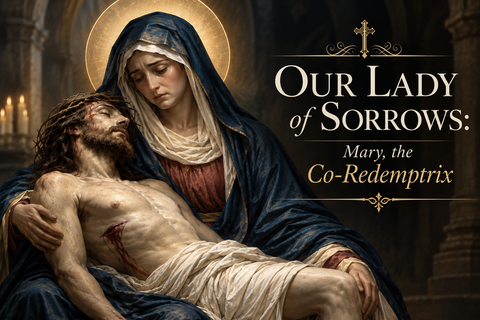
At Calvary, almost everyone had fled, but Mary remained. She stood beneath the Cross as the Son she had carried in her womb, raised in Nazareth and followed throughout His life was tortured and put to death before her eyes.
Mary did not merely witness His suffering. She suffered with Him. The nails did not pierce her hands and feet, but the Passion of her Son pierced her heart, fulfilling the prophecy Simeon had spoken decades earlier: “And you yourself a sword will pierce” (Luke 2:35).
Pope Benedict XVI reflected upon this mystery at Lourdes on the Feast of Our Lady of Sorrows in 2008. Speaking of Mary at Calvary, he said that she “certainly cried over the tortured body of her Son,” adding that Scripture's restraint prevents us from fully plumbing “the depths of her grief.”
Yet Mary's suffering was more than the natural sorrow of a mother watching her child die. Knowing that her Son had come to accomplish the Father's saving will, she remained united to Him and joined the suffering of her own maternal heart to His sacrifice. This suffering, freely accepted and offered in union with Jesus, is essential to understanding what generations of Catholic saints, theologians and popes have meant by Mary's participation in Redemption.
Jesus Christ alone is the Redeemer of mankind. His sacrifice possesses an infinite value that no creature can add to or complete. But God chose to associate Mary with the Redeemer in a singular way: through her fiat, her divine motherhood, her obedience, and ultimately through her suffering and offering at the foot of the Cross.
This is one of the deepest meanings behind the title Co-redemptrix. It does not mean another redeemer alongside Christ. It expresses Mary's unique cooperation with the Redeemer, entirely dependent upon Him and subordinate to Him.
Perhaps the simplest way to understand it is this: Jesus alone redeemed the world, but Mary uniquely participated in His work of Redemption, above all by uniting the suffering and offering of her maternal heart to His sacrifice on Calvary.
The New Eve: The Idea Begins in the Early Church
The theological foundation is far older than the title Co-redemptrix. From the earliest centuries, Christians recognized a profound parallel between Eve and Mary: through the disobedience of the first woman came death; through the obedience of another woman came the Savior.
St. Irenaeus of Lyons, writing in the second century, said of Mary: “Being obedient she became the cause of salvation for herself and for the whole human race.”
He also taught that the knot tied by Eve's disobedience was untied by Mary's obedience—an ancient Christian insight preserved today in the Catechism of the Catholic Church.
Centuries later, St. Ambrose wrote that “a Virgin has begotten the salvation of the world,” while St. Anselm addressed Mary as “the mother of justification and of the justified” and “the mother of salvation and of the saved.” St. John Paul II himself quoted these texts when explaining the ancient roots of Mary's maternal role in salvation.
None of these Fathers meant that Mary was a second source of salvation apart from Christ. Rather, they recognized that God deliberately incorporated Mary's free obedience into His saving plan. Mary's cooperation begins with her fiat, but it does not end there.
Mary's Fiat Began at Nazareth and Continued to Calvary
At the Annunciation Mary answered the angel: “Behold, I am the handmaid of the Lord. May it be done to me according to your word.” —Luke 1:38
That fiat was not simply permission for a biological event. Mary freely placed herself at the service of God's plan, giving the Eternal Word the human nature in which He would suffer, die and rise for our salvation.
St. John Paul II taught that Mary's cooperation gradually deepened as the saving mission of her Son unfolded. In his catechesis on the finding of Jesus in the Temple, he explained that Mary renewed her fiat and increasingly placed herself at the service of her Son's mission, thereby cooperating “in the mystery of Redemption.”
Her yes therefore became the pattern of her whole life. She accepted Simeon's prophecy, accompanied the unfolding mission of Jesus, endured the rejection directed against Him, and finally followed Him to the Cross. John Paul II explicitly taught that through these sufferings Mary became more closely united to Christ and “co-operates in salvation.”
At Calvary, that lifelong fiat reached its most painful expression. Mary could do nothing to remove the nails without opposing the mission for which Christ had come. Instead she remained faithful to the Father's will, surrendering her Son and accepting in her own soul the sword Simeon had foretold.
St. Bernard: Mary's “Compassion” in the Sacrifice of Christ
St. Bernard of Clairvaux gave powerful expression to Mary's suffering with Christ. Pope Benedict XVI highlighted his teaching in a 2009 General Audience, quoting Bernard's meditation on the sword that pierced Mary's soul: “A sword has truly pierced your soul!”
Benedict explained that, for St. Bernard, Mary's participation in her Son's Passion surpassed even the bodily sufferings of martyrdom. He then summarized Bernard's theology by referring to Mary's “most particular participation (compassio) in the sacrifice of the Son.”
The Latin root of compassion is important: it means to suffer with. Mary's compassion at Calvary was therefore not distant sympathy. The suffering of Christ became the source of the Mother's profound suffering because of the extraordinary union of love between them.
Her suffering did not possess the infinite redemptive value of Christ's Passion. Yet because she united it entirely to Him, Catholic tradition saw in her sorrow something more than passive grief: a real participation in His sacrificial offering.
St. Pius X: Mary Shared in the Passion and the Work of Redemption
Pope St. Pius X developed this teaching with striking clarity in his 1904 encyclical Ad Diem Illum Laetissimum.
Reflecting on Mary beneath the Cross, he wrote that she was not merely contemplating “the cruel spectacle.” Rather, she so completely participated in Christ's Passion that, had it been possible, she would willingly have endured all the torments suffered by her Son. St. Pius then described Mary as “the associate in His passion.”
He went further. Because of Mary's extraordinary holiness and union with Christ, St. Pius taught that she “has been associated by Jesus Christ in the work of redemption.”
The Pope was careful to distinguish Mary's role from Christ's. The power to produce grace belongs to God alone; Mary's cooperation derives wholly from Christ and depends upon Him. Nevertheless, St. Pius clearly taught that her intimate union with Jesus included participation in His redemptive work.
This is precisely the distinction necessary for understanding Co-redemptrix: not equality with the Redeemer, but unique association with Him.
Benedict XV: Mary Suffered With Christ and Offered Her Son
Pope Benedict XV expressed the connection between Mary's suffering and Redemption even more forcefully in the 1918 Apostolic Letter Inter Sodalicia.
The original document speaks explicitly of the prayers and sorrows of the Virgin standing at the Cross of Jesus. In the passage traditionally cited from the letter, Benedict XV teaches that Mary suffered with her suffering and dying Son, surrendered her maternal rights for the salvation of humanity, and, insofar as it belonged to her, offered her Son.
He concluded that because of this union with Christ's sacrifice, it could rightly be said that she “together with Christ has redeemed the human race.”
Read correctly, this extraordinary language does not create two redeemers. Benedict XV is describing the profound union between Christ's objectively redemptive sacrifice and Mary's subordinate participation in it: He suffers; she suffers with Him. He offers Himself; she consents to and participates maternally in that offering.
Pius XI: Mary as Co-redemptrix
The language eventually developed into the explicit papal use of the title Co-redemptrix. Pope Pius XI employed the term on several occasions.
In his 1935 radio message connected with Lourdes and the Jubilee of the Redemption, he addressed Mary as the Co-redemptrix who stood beside her suffering Son, explicitly joining the title to her suffering with Jesus while He consummated the Redemption on the Cross.
This historical usage helps clarify what Co-redemptrix meant in traditional Catholic theology. The title was especially associated with Calvary, compassion and union with Christ's sacrifice. Mary's co-redemption was not another work beside Christ's Redemption; it was her unique participation within the work accomplished by Him.
Pius XII: Mary “Offered Him on Golgotha”
Pope Pius XII gave perhaps one of the clearest papal descriptions of Mary's offering at Calvary in his 1943 encyclical Mystici Corporis Christi. Calling Mary the second Eve, he taught that she “offered Him on Golgotha to the Eternal Father” for the children of Adam. Pius XII added that her “mother's rights and her mother's love were included in the holocaust.”
This is a remarkable statement. Mary does not merely watch Christ offer Himself. In the language of Pius XII, she participates maternally in His offering, surrendering the Son she loves and accepting the terrible sorrow that this surrender brings.
In Ad Caeli Reginam he returned to the same doctrine, teaching that Mary was “most closely associated with Christ” in accomplishing Redemption and that she participated uniquely by giving Christ His human nature, “freely offering Him for us,” and taking an active part in our salvation.
St. John Paul II: Mary Cooperated During the Redemptive Event Itself
St. John Paul II developed Marian cooperation with particular depth. His 1997 catecheses are especially important because he distinguished Mary's cooperation from that of every other Christian.
All believers can cooperate in spreading the fruits of Redemption through prayer, sacrifice and apostolic work. Mary, however, was different. John Paul II taught: “Mary… co-operated during the event itself and in the role of mother.”
He continued by saying that Mary “alone was associated in this way with the redemptive sacrifice” and that, “in union with Christ and in submission to him,” she collaborated in obtaining the grace of salvation for humanity.
Those qualifications are crucial. In union with Christ. In submission to Christ. Her cooperation is real precisely because it is dependent upon the one Redeemer.
John Paul II also repeatedly linked Mary's cooperation to suffering. Through the trials, rejection and sorrow she endured with her Son, her union with Him deepened all the way to Calvary. For John Paul II, Marian co-redemption includes the whole movement from Nazareth to the Cross: obedience, motherhood, suffering, self-offering and intimate union with Christ's sacrifice.
Benedict XVI: Completely Involved in the Redemptive Mission of Jesus
Pope Benedict XVI did not use the title Co-redemptrix in the papal texts cited here. What he did teach explicitly, however, was the underlying reality of Mary's deep participation in Christ's saving mission.
In Sacramentum Caritatis, Benedict XVI wrote that Mary's abandonment to God's will deepened as she became “completely involved in the redemptive mission of Jesus.”
He then described Mary as persevering in union with Jesus to the Cross, “suffering deeply with her only-begotten Son, associating herself with his sacrifice in her mother's heart, and lovingly consenting to the immolation” of the Son born of her.
This is an extraordinarily rich description of what Marian co-redemption seeks to express. Mary suffers with Christ, internally associates herself with His sacrifice, and consents in love to the immolation of the Victim.
Benedict XVI therefore helps us understand an essential dimension of the tradition: Mary's union with Christ is not sentimental closeness. It passes through the Cross.
Cardinal Burke: “The Blessed Virgin Mary Is Co-Redemptrix”
Cardinal Raymond Leo Burke has recently expressed the same theology in direct terms.
In a September 2026 address, Cardinal Burke first emphasized that nothing is lacking in the sacrifice of Christ: “It is perfect and procures divine grace and eternal life…”
He then described Mary's “irreplaceable cooperation in the Mystery of the Redemptive Incarnation.”
He stated plainly: “The Blessed Virgin Mary is Co-Redemptrix” and immediately explained what he meant: “She participates in Our Lord's saving work, in a unique way.”
Cardinal Burke's definition preserves the necessary distinction within the title itself. Christ's sacrifice is perfect. Mary's role is participation in His saving work, not an independent work alongside it.
Co-redemptrix Means Suffering With the Redeemer
When the testimony of these saints, theologians and popes is placed together, a consistent pattern appears. Mary's cooperation begins at Nazareth when she freely says yes to becoming the Mother of the Redeemer, but it reaches its most intense expression at Calvary.
The sword enters Mary's soul because the nails enter the flesh of Jesus. She cannot suffer His Passion in the same manner that He suffers it, nor can her suffering possess the infinite redemptive value of the God-man's sacrifice. Yet because she loves Him with a mother's immaculate heart and freely remains united to His saving mission, she suffers with Him and offers that suffering in union with His.
This is why Pius XII could say that she offered Christ to the Eternal Father, why St. Pius X called her an associate in His Passion, why Benedict XV spoke of her suffering with her dying Son, why St. John Paul II taught that she cooperated during the redemptive event itself, and why Benedict XVI described her as associating herself with Christ's sacrifice in her maternal heart.
The title Co-redemptrix, properly understood, is therefore profoundly Christ-centered. It says nothing about Mary apart from Jesus. It describes Mary precisely in relation to Jesus: receiving Him, giving Him to the world, following Him, suffering with Him and surrendering herself to the Father's will beside His Cross.
With Jesus
The central insight of the earlier reflection on Mary as Co-redemptrix was expressed simply as “with Jesus.” That idea remains true, but Calvary reveals how demanding those words really are.
To be with Jesus at Bethlehem meant joy. To be with Him at Nazareth meant hidden faithfulness. But to remain with Jesus at Calvary meant allowing the sufferings of the Crucified One to pierce her own heart while continuing to surrender herself to the Father's will.
Mary did not take back the fiat of Nazareth when it became unbearably painful. She remained beneath the Cross, loving Christ, suffering with Christ, and uniting the sorrow of her heart to the sacrifice He offered for the salvation of the world.
That is the heart of Marian co-redemption. Christ is the one Redeemer; everything comes from Him and depends upon Him. Yet in the mysterious generosity of God, the woman who first gave Him her fiat was also permitted to accompany Him to the supreme hour of Redemption and to offer, in union with Him, the immeasurable suffering of a mother's heart.
With Jesus—even at the Cross.