The letter should have been ordinary.
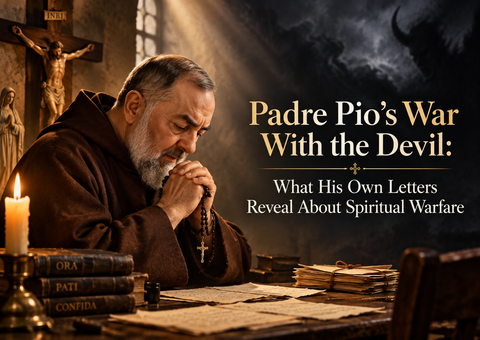
It arrived in Pietrelcina in November 1912 from Padre Pio’s spiritual director, Padre Agostino. But when Padre Pio and the local archpriest opened it, they found the pages so heavily stained with ink that the words were almost impossible to read.
Padre Pio immediately suspected the adversary he believed had been tormenting him for months: the devil.
According to Padre Pio’s account, they placed a crucifix over the letter and used holy water. Enough of the writing then became visible for them to decipher it with difficulty. The archpriest later signed a statement attesting that the letter had arrived stained and initially unreadable.
It sounds like the beginning of a supernatural story. But the stained letter was not the most important part.
Because when we read Padre Pio’s correspondence closely, a disturbing pattern emerges. Satan was not merely trying to frighten him. The devil was trying to separate Padre Pio from the very things keeping him close to God.
And that battle had begun long before the letter arrived.
The Devil Began With Despair
In 1911, Padre Pio was still a young priest living in his hometown of Pietrelcina because of persistent illness. His outward life was quiet—prayer, sickness and correspondence with his superiors—but his letters reveal an intense interior battle.
Writing to Padre Benedetto in June 1911, Padre Pio said that the “common enemy,” meaning the devil, continued to wage war against him. Satan was bringing painful memories before his mind and suggesting thoughts of despair.
This is important because the devil did not begin with some spectacular apparition. He began in Padre Pio’s thoughts, confronting him with his past and trying to make him lose hope in God’s mercy.
Padre Pio responded in precisely the opposite direction. He credited the Blessed Virgin Mary with helping him resist these attacks and wrote that his suffering only increased his need to abandon himself more confidently to divine mercy.
Satan wanted Padre Pio looking inward at his weakness. Padre Pio kept turning toward God.
But the devil did not stop there.
“The Battles Do Not Cease”
By February 28, 1912, the conflict had intensified. Padre Pio wrote to Padre Agostino that the strange “visits” were becoming more frequent and then summarized his situation with an unsettling sentence: “The battles do not cease.”
Padre Pio referred to the demons as quei cosacci—roughly, “those ugly wretches.” The official Padre Pio portal explicitly identifies them as devils, yet the same letter also records Padre Pio’s confidence that ultimately there was nothing to fear.
This tension runs throughout his correspondence. The devil was real, and the attacks were serious—but Satan was never sovereign.
Soon, however, Padre Pio began to see that one of Satan’s principal targets was not merely his peace of mind. The devil wanted to interfere with the relationship that was helping Padre Pio discern what was happening to him.
Satan Wanted Padre Pio to Stop Talking
On November 18, 1912, Padre Pio revealed something particularly striking to Padre Agostino. He wrote that the devil continually troubled him and tried to “poison” his life through infernal snares—but Satan seemed especially disturbed by the fact that Padre Pio kept telling his spiritual director about them.
The temptation was subtle. Padre Pio said the devil urged him to stop describing the struggle between them and instead write only about the beautiful, edifying spiritual experiences he received.
At first glance, the suggestion might almost have sounded pious. Why dwell on ugly temptations? Why trouble a spiritual director with them when he could speak instead about consolation and grace?
Padre Pio recognized the trap.
Satan wanted secrecy.
If the devil could persuade him to stop speaking honestly, Padre Pio would become more isolated. And a soul fighting alone is easier to confuse and discourage than one bringing its struggles into the light through sound spiritual direction.
So Padre Pio kept writing—and according to his letters, the conflict intensified.
Then the Attacks Became Physical
Padre Pio’s correspondence contains accounts far more disturbing than interior temptation.
In a letter describing one such night, he wrote that strange noises began before figures he believed to be demons appeared in horrifying forms. Padre Pio said they attacked him, threw him to the ground, struck him, scattered objects around the room and shouted obscenities.
These extraordinary incidents should be presented carefully. They are Padre Pio’s own testimony about experiences that he understood as demonic attacks.
But even here, the physical violence was not the deepest danger. Satan’s ultimate objective, as Padre Pio understood it, was not simply to frighten or hurt him. The devil wanted him to fall—to surrender to temptation, abandon trust in God, or turn away from the path he believed God had given him.
That is why the spectacle of the attacks can actually distract us from the more important battle.
The real struggle was over Padre Pio’s soul.
The Devil’s Most Dangerous Weapon Was Despair
We naturally remember the dramatic stories: the noises in the night, the blows, the grotesque figures and the mysterious letters.
Yet Padre Pio’s own correspondence repeatedly points to something quieter and potentially more dangerous. Satan wanted to convince him that he had been abandoned by God.
Think about what that temptation accomplishes. If the devil can persuade a person that God no longer wants him, prayer begins to feel pointless. Confession begins to seem useless. Hope slowly gives way to discouragement, and discouragement can eventually lead to surrender.
Padre Pio had already learned where to fight that temptation. When Satan presented his failures and weaknesses before him, Padre Pio deliberately placed greater confidence in divine mercy. When the devil pushed him toward isolation, he remained connected to his spiritual directors. When fear grew, he turned toward Jesus and Our Lady.
This is one of the great paradoxes of Padre Pio’s spiritual warfare: the devil wanted to become the center of his attention, but Padre Pio continually redirected his attention toward Christ.
And over time, that became his great defense.
Why Was Satan Fighting Padre Pio So Fiercely?
Padre Pio did not understand his struggle as something affecting him alone. His priesthood would eventually become dedicated to bringing enormous numbers of people back to God, especially through the Mass and Confession.
John Paul II described Padre Pio’s life as an “endless spiritual combat” sustained by prayer and centered on the daily sacred acts of Confession and the Mass. He called the altar and the confessional the two focal points of Padre Pio’s priestly life.
There is a profound spiritual logic here.
Satan tempts souls toward sin; Padre Pio spent countless hours reconciling sinners to God. The devil encourages secrecy; Padre Pio called penitents to bring sin into the light. Satan whispers that forgiveness is impossible; through the sacrament of Reconciliation, Padre Pio repeatedly announced that the mercy of Christ was greater than sin.
Every authentic conversion reversed the work the devil wanted to accomplish.
And Padre Pio would spend decades doing exactly that.
Padre Pio’s Weapons Against the Devil
When Benedict XVI visited San Giovanni Rotondo in 2009, he spoke directly about this aspect of Padre Pio’s life. Benedict said Padre Pio’s greatest “storms” were “the assaults of the devil.”
But he immediately turned attention away from Satan and toward the way Padre Pio resisted him. Benedict described Padre Pio defending himself with the biblical “armour of God,” the “shield of faith,” and the “sword of the Spirit,” the Word of God—and above all by remaining united to Jesus.
That is the heart of Padre Pio’s spiritual warfare.
His weapons were not exotic. They were the spiritual treasures already entrusted to Catholics: prayer, Sacred Scripture, the Holy Mass, Confession, the Rosary, devotion to Our Lady, obedience, spiritual direction and persistent trust in Jesus.
Benedict XVI described Padre Pio’s days as almost “a Rosary lived,” a continual meditation on Christ in spiritual union with Mary. John Paul II likewise emphasized that his lifelong combat was sustained by prayer and revolved around the altar and confessional.
Even the strange battle over Padre Pio’s letters reveals the same pattern. In December 1912, he wrote that he had sprinkled one of Padre Agostino’s letters with holy water before opening it because he believed the devil was trying to interfere with their correspondence. He remained convinced that Satan was using “diabolical arts,” but he was equally convinced that the devil would ultimately fail.
Satan attacked in extraordinary ways.
Padre Pio answered with the ordinary means of grace.
What Was the Devil Really Trying to Steal?
Step back from the individual stories and a pattern becomes clear.
Satan tempted Padre Pio toward despair, disturbed his peace, tried to interfere with his spiritual direction, encouraged secrecy, frightened him and attempted to exhaust him. The methods changed, but the target remained remarkably consistent.
The devil wanted Padre Pio’s trust in God.
That is what makes these century-old letters relevant to Christians today. Most of us will never experience the extraordinary phenomena Padre Pio described, but Satan does not require an apparition or a physical attack to tempt a soul.
Sometimes all that is needed is a thought: God must be tired of forgiving me. I have failed too many times. There is no point praying anymore. Why confess the same sin again? I should keep this struggle to myself.
Padre Pio would have recognized that battlefield.
And his response was remarkably straightforward: when Satan says there is no hope, trust Jesus more. When the devil tells you to hide your sin, bring it to Confession. When Satan urges you to fight alone, seek sound spiritual guidance. When prayer becomes difficult, continue praying. When fear grows, turn toward Christ rather than becoming fascinated with the fear itself.
The devil may tempt. He may frighten. He may lie.
But he cannot force a soul to abandon God.
The Devil Does Not Get the Last Word
That is why the most extraordinary part of Padre Pio’s war with the devil is not the stained letter, the noises in the night or even the physical attacks he described.
It is what happened afterward.
Satan wanted Padre Pio to despair; he became an apostle of hope. The devil wanted his struggles hidden; Padre Pio’s letters still expose Satan’s tactics more than a century later. Satan wanted sin kept in darkness; Padre Pio spent his priesthood in the confessional bringing sinners into the mercy of Christ.
And while the devil wanted Padre Pio separated from God, the battles appear to have driven him more deeply toward Jesus.
Benedict XVI captured the outcome when he described Padre Pio’s struggle with the spirit of evil and then summarized his mission very differently: to guide souls and alleviate suffering. The devil may have attacked him, but Satan did not define the direction of Padre Pio’s life.
Christ did.
Perhaps that is the greatest lesson hidden within these extraordinary letters. Satan can enter the battle, and the devil can make the battle painful. But for the soul that continues to cling to Jesus, the devil does not get to decide how the story ends.
Jesus does.
St. Padre Pio, pray for us. In moments of temptation, fear and discouragement, help us reject the lies of the devil, remain close to the sacraments, seek the protection of Our Lady, and place all our trust in Jesus Christ. Amen.