
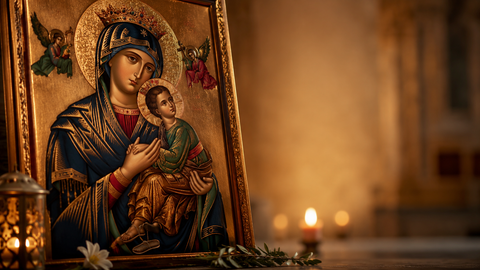
Many Catholics have seen the image of Our Mother of Perpetual Help countless times. It may be hanging in a parish church, placed on a family altar, tucked inside a prayer book, or printed on a small novena card. The image is so familiar that we may think we already know it by heart. But near the bottom of the icon is one small detail that many people miss: the Child Jesus’ sandal is slipping from His foot.
Once you notice it, you may never look at the icon the same way again. That loose sandal is not a random artistic detail. It tells a tender story about fear, trust, and a child running into the arms of his mother. It also helps us understand why Mary is called Our Mother of Perpetual Help.
A Beloved Image Many Catholics Know by Heart
Our Mother of Perpetual Help is one of the most beloved Marian devotions among Filipino Catholics. Many grew up seeing her image in churches, homes, classrooms, stores, and prayer corners. For countless families, her face is connected with petitions whispered in worry, thanksgiving offered in relief, and the steady rhythm of Wednesday devotion.
But the Mother of Perpetual Help icon is more than a beautiful religious image. It is a kind of visual prayer, inviting us to look slowly and enter the mystery it presents. Every gesture, every gaze, and every object in the icon points us toward Jesus. Mary is never shown as separate from her Son, because her motherly help always leads us closer to Him.
The Icon Is Telling a Story
In the icon, Mary holds the Child Jesus close to her heart. On either side, the angels carry the instruments of the Passion: the cross, nails, lance, sponge, and vessel. Jesus sees these signs of the suffering that awaits Him, and His little body turns toward His Mother. His hands cling to her hand, as if seeking safety in the moment of fear.
Mary’s face, however, is turned toward us. She is holding Jesus, but she is also looking at the children who come before her image with their own burdens. The icon shows both the suffering that awaits Christ and the motherly tenderness that receives Him. It is an image of the Passion, but also an image of refuge.
The Loose Sandal — The Detail Many People Miss
Now look at the feet of the Child Jesus. One sandal remains secure, while the other is slipping away. In devotional tradition, this loose sandal is often understood as a sign of the haste with which Jesus has run to His Mother. Frightened by the vision of His Passion, He turns quickly toward Mary’s embrace.
This detail makes the icon deeply human and tender. Jesus is not shown as distant, cold, or untouched by suffering. He is true God, but He is also true man, and the icon invites us to contemplate His real humanity with reverence. The loose sandal reminds us that the Son of God entered fully into our human fear, weakness, and need.
That little sandal also speaks to our own lives. Fear does not have to drive us away from God. Suffering does not have to leave us isolated. Like the Child Jesus in the icon, our fear can become the very moment we run into the arms of grace.

Mary’s Hands: Holding Jesus, Helping Us
Mary’s hands are among the most beautiful parts of the icon. One hand holds Jesus securely, while the other gently directs our attention to Him. She does not keep Jesus away from us, nor does she take His place. She presents Him, protects Him, and leads our gaze back to Him.
This is what Mary does for every soul who comes to her. She helps us by helping us remain close to Jesus. When we are afraid, confused, ashamed, grieving, or spiritually tired, she teaches us not to run away from her Son. She teaches us to run toward Him with the trust of a child.
What “Perpetual Help” Really Means
The word “perpetual” can be deeply consoling when we understand it with faith. It does not mean Mary removes every cross immediately or answers every prayer in the exact way we imagine. It means her motherly intercession does not fail, because her care is rooted in her love for Jesus and for the children He gave to her. She remains near, especially when we feel weak or uncertain.
Many devotees come to Our Mother of Perpetual Help with urgent prayers. Some ask for healing, peace in the family, work, forgiveness, protection, or strength to carry a hidden burden. Some prayers are answered quickly, while some crosses remain for a time. Yet Mary’s help is constant because her mission is always to keep us close to Jesus.
How to Pray Before the Icon
The next time you pray before the Mother of Perpetual Help icon, begin by looking slowly. Look at the Child Jesus, His small hands, His startled movement, and the sandal slipping from His foot. Let the image remind you that Jesus knows human fear, and that Mary knows how to receive frightened children.
You can pray very simply before the icon. Notice the loose sandal, and place your own fear before Mary. Tell her what makes you anxious, what you are carrying, and where you feel weak. Then ask her to hold you close to Jesus, not only when life is peaceful, but especially when your heart trembles.
Our Mother of Perpetual Help, when I am afraid, teach me to run to Jesus. Hold me close to Him, and help me trust that I am never alone. Lead me always to your Son. Amen.
Look Again
The next time you see the icon of Our Mother of Perpetual Help, look again. Look not only at Mary’s face, but also at the Child Jesus and the little sandal slipping from His foot. Let that small detail remind you that God truly entered our human life, even our fear and trembling.
And let it remind you that Mary is not far from you. In every anxiety, every burden, and every trembling prayer, we may run to Mary. And Mary, Our Mother of Perpetual Help, will always lead us to her Son.