
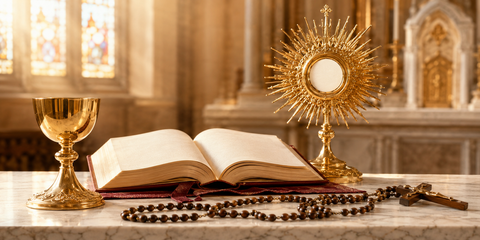
On November 2, 1946, a newly ordained Father Karol Wojtyła celebrated his first Mass in the Crypt of Saint Leonard beneath Wawel Cathedral in Kraków. More than fifty years later, as Saint John Paul II reflected on his Eucharistic life, he remembered how his eyes had returned daily to the consecrated Host and chalice.
That first Mass was not simply the beginning of his priestly duties. It marked the beginning of a lifelong return to Jesus—at the altar, in prayer with Mary, and before Christ in the Blessed Sacrament.
Our own prayer lives may look much less remarkable. We may arrive at Sunday Mass after a hurried morning, begin a Rosary we do not finish, or sit in a chapel while our minds wander through responsibilities waiting at home. Yet beneath our distractions is often a sincere desire: Lord, teach me to pray and remain close to You.
A strong Catholic prayer life is not built through one perfect spiritual moment. It grows through repeated return: to Jesus in the Holy Mass, to the mysteries of Christ with Mary in the Rosary, and to His Eucharistic presence in Adoration.
The Saints Did Not Treat Prayer as an Extra
For the saints, prayer was not an activity added after everything important had been completed. Prayer shaped how they served, suffered, discerned, and loved.
Their lives were not free from exhaustion, uncertainty, or difficulty. Saint John Paul II carried heavy responsibilities throughout his priesthood and papacy. Nevertheless, he continued to return to the altar, the Rosary, and prayer before the Eucharist.
This teaches us something essential. Prayer is more than completing a religious routine. It is a relationship in which we bring our lives before God and allow His grace to shape how we live them.
The Holy Mass, Rosary, and Eucharistic Adoration are not three competing practices. Each is centered on Jesus Christ, although each helps us encounter Him in a particular way. The Mass remains the source and summit of the Christian life. The Rosary helps us contemplate Jesus with Mary, while Adoration allows us to remain before the Lord whose Eucharistic presence comes from the celebration of the Mass.
Holy Mass: Returning to Christ’s Sacrifice and Gift
When Saint John Paul II looked back on more than half a century of priesthood, he described his daily return to the Eucharist beginning with his first Mass in Kraków. The altar remained the center of his priestly life because the Eucharist was not merely one devotion among many. It was Christ giving Himself to His Church.
The Mass is more than a gathering of believers or an opportunity to hear an encouraging message. In the Eucharistic celebration, Christ’s one sacrifice on Calvary is made sacramentally present. It is not another sacrifice added to the Cross, nor is it only a symbolic reenactment.
Saint John Chrysostom expressed this mystery simply: “We always offer the same Lamb, not one today and another tomorrow.” Saint John Paul II cited these words when explaining that the sacrifice of Christ and the Eucharistic sacrifice are one sacrifice.
At every Mass, the Church receives the same Jesus who offered Himself for our salvation. He gives us His Body and Blood as true spiritual food and invites us to unite our lives with His perfect offering to the Father.
This is why the Catechism calls the Eucharist “the source and summit of the Christian life.” Everything in the life of the Church is directed toward Christ in the Eucharist and draws strength from Him.
Our experience of Mass, however, may not always feel profound. We may be distracted by a crying child, burdened by a family problem, tired after a week of work, or spiritually dry. The value of the Mass does not depend on the intensity of our feelings. Christ remains faithful and truly present even when our attention and emotions are weak.
We can participate more intentionally through a few simple practices:
- Bring one clear intention to the altar: a loved one, a decision, a sorrow, or an act of thanksgiving.
- Arrive a few minutes early when circumstances allow.
- Listen for one phrase in the readings that you can carry into the week.
- Unite your work, sacrifices, illness, or family responsibilities with Christ’s offering.
- Receive Holy Communion worthily and reverently.
- Remain briefly after Mass to thank Jesus for coming to you.
- Choose one grace from the Mass to practice at home through patience, forgiveness, or service.
For parents of young children, faithful participation may involve frequent interruptions. For caregivers, shift workers, and those facing illness, simply reaching the church may require sacrifice. These efforts can also be placed upon the altar.
The Mass does not remove us from ordinary life. It teaches us how to offer ordinary life to God.
The Holy Rosary: Looking at Jesus With Mary
The Rosary accompanied Saint John Paul II from his youth. It remained with him during moments of joy and difficulty, and he entrusted countless concerns to this prayer.
“The Rosary is my favourite prayer. A marvellous prayer!” he said shortly after his election as pope. His love for the Rosary was not a departure from his love for Christ. It grew from his desire to contemplate the face of Jesus with His Mother.
The Rosary is deeply Marian and fully Christ-centered. Its mysteries lead us through the Incarnation, public ministry, Passion, death, Resurrection, and glory of Jesus. Mary does not draw attention away from her Son. She helps us remain with Him and ponder His saving work.
The repetition of the Hail Mary can sometimes feel mechanical, especially when we are tired or distracted. Yet repetition is meant to provide a steady rhythm beneath our contemplation. As our lips pray familiar words, our hearts can rest upon the mystery of Christ.
A mother may pray one decade before the household wakes. A family Rosary may be interrupted by restless children. Someone commuting to work may offer a decade for a loved one. A person experiencing grief may be able to pray only one slow Hail Mary at a time.
These are not necessarily failed prayers.
When distractions come, we do not need to become discouraged or begin again repeatedly. We can acknowledge the distraction, entrust it to God, and gently return to the mystery. Sometimes the very concern interrupting our prayer is the concern we need to place in the hands of Jesus and Mary.
If praying the full Rosary each day feels overwhelming, begin with one decade. Announce the mystery, read a short verse of Scripture, and pause to picture the Gospel scene. Offer that decade for one person or need.
The goal is not to rush through a required number of words. It is to stay near Jesus with Mary. Over time, the mysteries begin to accompany us beyond the prayer itself: the humility of Nazareth enters our family life, the patience of Christ strengthens us in suffering, and the joy of the Resurrection renews our hope.

Eucharistic Adoration: Bringing Life Before Jesus
Saint John Paul II’s decisions and responsibilities were sustained by prayer before the Eucharistic Lord. In Ecclesia de Eucharistia, he testified that he had often spent time in silent Adoration and drawn from it strength, consolation, and support.
This offers a beautiful pattern for our own lives. We can bring family decisions, parenting concerns, financial worries, illness, work burdens, vocational uncertainty, and grief before the tabernacle. We do not need to arrive with polished words or immediate answers.
The Catechism recalls the simple explanation given by a farmer of Ars about his prayer before the tabernacle: “I look at him and he looks at me.”
That quiet exchange reveals the heart of Adoration. Jesus Christ is truly present in the Blessed Sacrament—Body, Blood, Soul, and Divinity. Eucharistic Adoration is therefore not worship of an object or symbol. It is worship of Christ Himself.
Adoration flows from the Mass because Christ’s presence under the Eucharistic species begins with the celebration of the Eucharistic sacrifice. It also leads us back to the Mass with deeper faith, gratitude, and desire for communion. Adoration never replaces our obligation to participate in Sunday Mass.
Some people avoid the Adoration chapel because they do not know what to do there. They imagine that a Holy Hour must be filled with uninterrupted concentration or many formal prayers. In reality, silence offered with faith can be genuine prayer.
A simple visit might look like this:
- Acknowledge that Jesus is truly present.
- Offer Him one burden, person, or decision.
- Read a short Gospel passage.
- Remain silently and allow yourself to be seen by Christ.
- Pray a decade of the Rosary if it helps you remain attentive.
- End by thanking Jesus for His presence and care.
Ten quiet minutes before the tabernacle can be a meaningful beginning. If your thoughts wander, return gently. If you feel no consolation, remain in faith. Love is sometimes expressed most sincerely by choosing to stay.
One Prayer Life, Not Three Separate Practices
The three pillars belong to one Catholic prayer life.
At Mass, Christ draws us into His saving sacrifice and gives Himself to us in Holy Communion. In the Rosary, Mary teaches us to contemplate the mysteries of her Son. In Eucharistic Adoration, we remain before the same Lord who gives Himself at the altar.
This unity was visible in Saint John Paul II’s life. The Eucharist formed its center. The Rosary accompanied his joys, trials, and responsibilities. Silent prayer before Christ became a source of strength and discernment.
The same unity can slowly take shape within our homes and parishes. The Gospel heard at Sunday Mass may become the Scripture passage we ponder during the Rosary. A family intention offered in one decade may later be carried before the tabernacle. Time in Adoration may deepen our hunger to receive Jesus reverently at the next Mass.
Which pillar is already strong in your life? Which one might Jesus be inviting you to rediscover?
A Realistic Weekly Rhythm of Prayer
A sustainable prayer rhythm should lead us toward faithful love, not constant discouragement. Different seasons of life require different patterns.
For the Holy Mass:
- Participate faithfully in Sunday Mass.
- Bring one intention to the altar each week.
- Prepare for a worthy and reverent reception of Holy Communion.
- Attend a weekday Mass occasionally when circumstances allow.
For the Holy Rosary, choose a realistic beginning:
- Pray one decade each day.
- Pray a full Rosary several times a week.
- Choose one evening for a family Rosary.
- Pray one mystery slowly with a related Scripture passage.
For Eucharistic Adoration, consider:
- A weekly chapel visit.
- A monthly Holy Hour.
- Ten minutes before the tabernacle.
- A short visit before or after another parish activity.
Parents caring for small children may need to pray in brief intervals. Caregivers may find their prayer continually interrupted by the needs of another person. Shift workers, the ill, and Catholics living far from a parish may not be able to follow a conventional schedule.
God sees these circumstances. The purpose of a prayer rhythm is not to compare our lives with someone else’s. It is to help us return faithfully to Jesus within the life we have actually been given.
Begin by Returning
Ordinary Time reminds us that holiness is formed amid ordinary duties. Meals must be prepared, children guided, work completed, appointments kept, and loved ones cared for. These responsibilities do not have to compete with prayer. They can become part of the life we bring to Jesus.
Saint Alphonsus Liguori described prayer as “a safe anchor for those who are in danger of shipwreck.” An anchor does not prevent every storm, but it keeps a vessel from being carried helplessly away. In a similar way, prayer keeps our lives rooted in Christ through uncertainty, dryness, and change.
The saints did not become holy because every prayer felt successful. They grew through grace and repeated fidelity. They returned after distraction. They continued through suffering. They allowed God to begin again in them.
If your prayer life has been neglected, begin by returning. Attend Sunday Mass with one sincere intention. Pray one decade of the Rosary with Mary. Sit before the tabernacle for ten quiet minutes.
Jesus is not asking you to create a perfect spiritual life in one day. He is inviting you to come back to Him.
Mary, who treasured the mysteries of Christ in her heart, will help you make that return. She always leads her children toward her Son.
A Prayer for a Life Rooted in Jesus
Lord Jesus, deepen within us a faithful love for the Holy Mass, where You make present Your saving sacrifice and give Yourself as food for our journey. Teach us to contemplate Your life with Mary, especially when our Rosaries are distracted or unfinished. Draw us often before Your Eucharistic presence, where we may place our families, decisions, sorrows, and hopes into Your hands. Strengthen parents, caregivers, workers, the sick, and all who struggle to find time for prayer. During seasons of spiritual dryness, keep us faithful even when we feel little consolation. Through the gentle guidance of Our Lady, help us return to You again and again—at the altar, in the mysteries of the Rosary, and before the Blessed Sacrament. Make our ordinary lives an offering of trust, love, and thanksgiving. Amen.