
The Epiphany is remembered for its movement.
A star cuts through the darkness. Wise men leave their homelands. Gifts are carried across deserts and borders. The nations begin their long approach toward the Light.
Yet when the Gospel finally brings us into the house at Bethlehem, everything grows still.
Saint Matthew tells us only this: “They saw the Child with Mary His Mother.”
No dialogue. No gestures. No recorded words.
And yet the Church has always known that this silence is not empty.
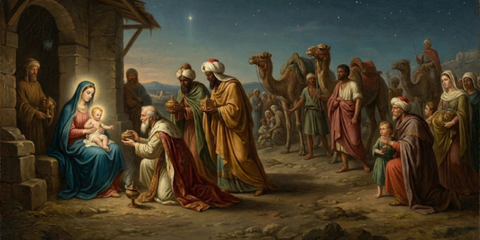
The Magi have reached the end of their journey. They fall to their knees before the Child, and gold, frankincense, and myrrh are placed at His feet. Christ is revealed as King, God, and Redeemer of all nations.
But beside Him stands the one who has been living this mystery long before the star appeared.
Mary is there—not as a bystander, but as the first adorer. She does not speak, yet she is fully present. She does not draw attention to herself, yet she is inseparable from the revelation unfolding before her.
The mystics do not add to the Gospel. Instead, they linger where Scripture invites us to linger—in the quiet space where the Mother of God watches the nations kneel before the Son she carried, nursed, and offered to the Father.
In their prayerful contemplation, the Epiphany becomes more than a moment of recognition by the Gentiles. It becomes a Marian mystery—one lived interiorly by the woman whose whole life was ordered toward presenting Christ to the world.

Mary’s Interior Adoration as the Nations Arrive
Among the great Marian mystics, Venerable Mary of Agreda offers one of the most profound contemplations of this moment. Her writings do not distract from Christ; they magnify His glory by revealing the interior participation of His Mother.
She invites us to stand inside the house with Mary—not as spectators, but as silent witnesses.
“The most blessed Mary was aware of the coming of the holy kings, and when they entered she held her divine Son in her arms with incomparable reverence and joy. She saw them prostrate themselves upon the ground, adoring Him as their true God and Redeemer, while offering Him gold, frankincense, and myrrh. The Queen of heaven united her interior acts of humility and adoration with theirs, giving thanks to the Lord because He was now known and worshipped by the nations. With ineffable wisdom she pondered in her heart all that was passing before her eyes.” — Venerable Mary of Agreda, The Mystical City of God
Here, the Epiphany unfolds on two levels at once. Outwardly, the Magi adore the Child. Inwardly, Mary adores Him with a depth no human heart can measure.
She does not instruct or explain. She simply unites her heart to the worship rising before her Son.
In this moment, Mary stands as the living sanctuary of the Incarnation—offering thanks not only as His Mother, but on behalf of all humanity now coming to Him. The nations have arrived, and she receives them in silence, already knowing what their homage means for the salvation of the world.
The Mother Who Presented the King
The Gospel tells us that the Magi “saw the Child with Mary His Mother.” This order is not accidental.
The mystics consistently affirm that it was through Mary’s maternal presence that the kings encountered the King. She does not draw attention to herself, yet she is inseparable from the mystery she bears.
“The heavenly Lady did not speak many words to the kings, for her silence was more eloquent than speech. By her modesty, her heavenly beauty, and her profound humility she confirmed their faith and inflamed their devotion. She offered her Son to them with a maternal tenderness full of reverence, knowing that He belonged to all nations and that she herself was but the handmaid of the divine will. In this offering she renewed her fiat, consenting anew to all that the Lord would accomplish through her Son for the salvation of the world.” — Venerable Mary of Agreda, The Mystical City of God
The Magi do not receive a theological discourse. They receive a Child—and they receive Him from His Mother.
Mary’s silence does not obscure Christ; it reveals Him. Her humility does not diminish His kingship; it confirms it. Without claiming Him as her own, she presents Him freely to the world.
In this way, the Epiphany becomes a Marian mystery precisely because Mary is perfectly transparent to the mission of her Son.
The Stillness of the Mother During the Act of Worship
Blessed Anne Catherine Emmerich dwells on the physical stillness of the moment, as though heaven itself paused while the nations bowed.
“Mary was seated with the Child Jesus upon her knee when the kings entered. She was recollected and grave, yet full of sweetness, and her whole bearing was one of humble majesty. She looked upon the strangers with a gentle seriousness, as one who understood the greatness of the hour without seeking to be seen. While they adored the Child, Mary adored Him interiorly with a depth and fervor no human heart could fathom. She offered Him to the eternal Father for the salvation of all peoples represented in those kings.” — Blessed Anne Catherine Emmerich, The Life of the Blessed Virgin Mary
What emerges from these mystical testimonies is not sentiment, but liturgy. The Epiphany unfolds as an act of worship, and Mary stands at its heart as the first contemplative of the Church.
Her adoration surpasses even that of the Magi—not because they are lacking, but because she knows Him whom she bore in a way no one else can. She is already living the vocation of the Church: to adore Christ and to offer Him to the Father for the life of the world.
The Gifts and the Shadow of the Cross
The gifts of the Magi are often explained symbolically. The mystics show us that Mary understands them personally.
“The most prudent Mother understood the mysteries signified by the gifts, and she penetrated their meaning with profound sorrow and love. In the gold she saw the kingship of her Son, in the frankincense His divinity, and in the myrrh the sufferings and death that awaited Him. She accepted all these things in silence, storing them in her heart, and she united herself to the divine will that had ordained such a path for the Redeemer.” — Venerable Mary of Agreda, The Mystical City of God
The Epiphany, then, is already shadowed by the Cross. The nations rejoice, unaware of the cost of redemption, while Mary rejoices and consents once more to the sacrifice love demands.
She holds together joy and sorrow, glory and suffering, manifestation and mystery. Even as Christ is revealed to the world, she is already offering Him back to the Father.
Mary’s Prayer After the Magi Depart
When the Magi leave, the Gospel falls silent again. The mystics allow us a final glimpse.
“When the kings had departed, Mary remained long in quiet prayer, adoring the Child and thanking God for the wonders He had worked. She asked that the light given to the nations might never be extinguished, and that all who sought the truth might be led to her Son. In her heart she embraced all peoples, offering them to Jesus with the same love with which she had offered Him to the Father.” — Blessed Anne Catherine Emmerich, The Life of the Blessed Virgin Mary
The star fades from the sky, and the kings return to distant lands. But Mary remains—praying, offering, loving.
The Epiphany continues, not in spectacle, but in hidden intercession.
A Marian Way of Living the Epiphany
To contemplate Mary before the wise men is to enter the quiet heart of the Epiphany. It is to recognize that the manifestation of Christ to the world passed through a human heart wholly surrendered to God.
In Mary, the Church learns how to present Christ without possessing Him, how to adore without claiming, and how to rejoice while consenting to sacrifice.
The Epiphany does not end at the manger. It continues wherever Christ is adored, wherever He is offered to the Father, wherever the nations are drawn to His light.
And in every such moment, the Mother who once sat silently in Bethlehem continues her hidden work—presenting the King to all who seek Him with sincere hearts.